
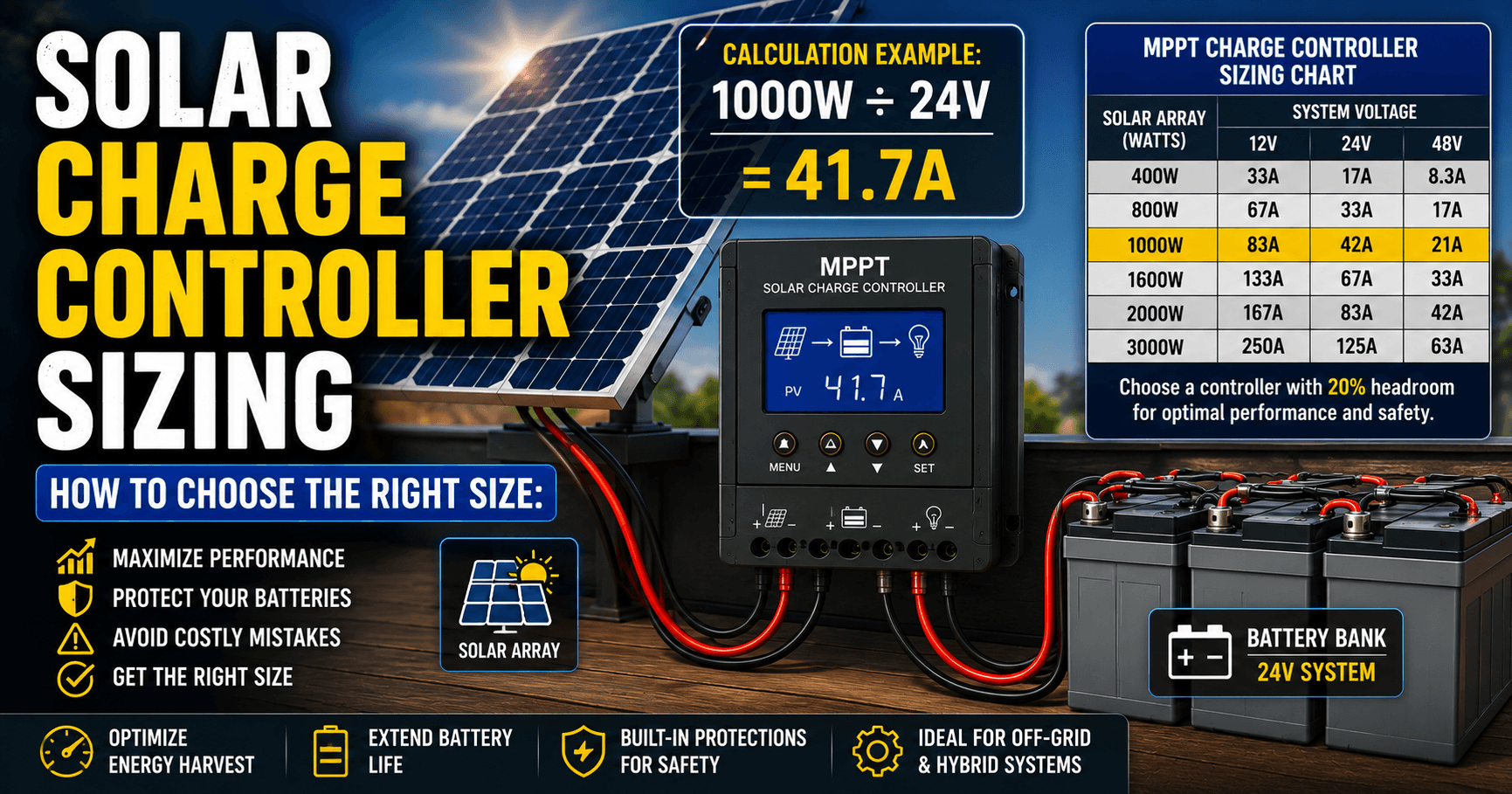

Proper solar charge controller sizing is critical for the safety, efficiency, and longevity of your solar power system. A charge controller that is too small may overheat, limit charging performance, or fail prematurely.
A controller that is too large may cost more than necessary. So how do you determine the right size charge controller?
The answer depends on:
- Solar panel wattage
- Battery voltage
- System type
- Safety margin
- Future expansion plans
In this guide, you’ll learn exactly how to size a solar charge controller for your solar system, along with practical examples and common sizing mistakes to avoid.
Quick Answer
To size a solar charge controller:
Formula
Charge Controller Current (A) = Solar Panel Wattage ÷ Battery Voltage
Then add a safety margin of 25%.
Example
Solar Array: 1000W
Battery Voltage: 24V
Calculation: 1000 ÷ 24 = 41.7A
Add 25% safety margin: 41.7 × 1.25 = 52A
Recommended Controller: 60A MPPT Charge Controller
What Is a Solar Charge Controller?
A solar charge controller regulates electricity flowing from solar panels to batteries.
Its main functions include:
- Preventing battery overcharging
- Preventing excessive discharge
- Protecting battery lifespan
- Improving charging efficiency
Without a properly sized controller, batteries and solar equipment can be damaged.
Why Proper Sizing Matters
Using the wrong controller size can lead to:
Controller Too Small
- Overheating
- Reduced charging performance
- Fault codes
- Premature failure
Controller Too Large
- Higher upfront cost
- Underutilized capacity
Although oversized controllers generally work safely, they may not be the most cost-effective choice.
Solar Charge Controller Sizing
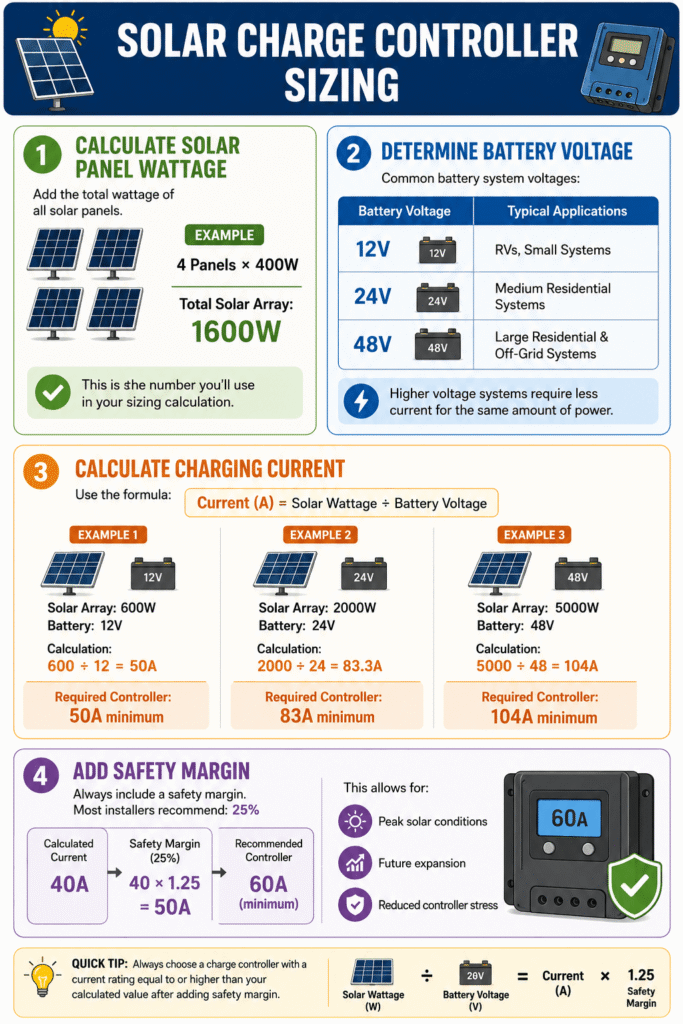
Step 1: Calculate Solar Panel Wattage
Add the total wattage of all solar panels.
Example
4 Panels × 400W
Total Solar Array: 1600W
This is the number you’ll use in your sizing calculation.
Step 2: Determine Battery Voltage
Common battery system voltages:
| Battery Voltage | Typical Applications |
|---|---|
| 12V | RVs, Small Systems |
| 24V | Medium Residential Systems |
| 48V | Large Residential & Off-Grid Systems |
Higher voltage systems require less current for the same amount of power.
Step 3: Calculate Charging Current
Use the formula: Current (A) = Solar Wattage ÷ Battery Voltage
Example 1
Solar Array: 600W
Battery: 12V
Calculation: 600 ÷ 12 = 50A
Required Controller: 50A minimum
Example 2
Solar Array: 2000W
Battery: 24V
Calculation: 2000 ÷ 24 = 83.3A
Required Controller: 83A minimum
Example 3
Solar Array: 5000W
Battery: 48V
Calculation: 5000 ÷ 48 = 104A
Required Controller: 104A minimum
Step 4: Add Safety Margin
Always include a safety margin.
Most installers recommend: 25%
Example
Calculated Current: 40A
Safety Margin: 40 × 1.25 = 50A
Recommended Controller: 60A
This allows for:
- Peak solar conditions
- Future expansion
- Reduced controller stress
Solar Charge Controller Sizing Chart
| Solar Array | 12V Battery | 24V Battery | 48V Battery |
|---|---|---|---|
| 200W | 20A | 10A | 10A |
| 500W | 60A | 30A | 20A |
| 1000W | 100A | 60A | 30A |
| 2000W | 200A | 100A | 60A |
| 5000W | Not Recommended | 250A | 125A |
These values include a basic safety margin.
MPPT vs PWM Sizing Considerations
Different controller technologies affect sizing.
PWM Controllers
Generally work best when:
- Solar panel voltage closely matches battery voltage
Common in:
- Small systems
- RV installations
MPPT Controllers
Offer:
- Higher efficiency
- Better charging performance
- More flexible panel configurations
Most residential systems use MPPT controllers.
Related Guide: MPPT vs PWM Charge Controller
Does Controller Type Affect Sizing?
The basic sizing formula is similar for both MPPT and PWM controllers, but MPPT controllers provide more flexibility.
PWM Example
Solar Panel:
- 400W
- 12V Battery
Controller Size: 400 ÷ 12 = 33A
Recommended: 40A PWM Controller
MPPT Example
Solar Panel:
- 400W
- 24V Battery
Controller Size: 400 ÷ 24 = 16.7A
Recommended: 20A MPPT Controller
MPPT controllers often allow higher panel voltages and more efficient energy conversion.
Sizing for Lithium Batteries
Lithium batteries often support:
- Higher charging currents
- Faster charging
- Deeper cycling
Because of this, many lithium battery systems use MPPT controllers.
Example
Battery: 48V Lithium
Solar Array: 4800W
Current: 4800 ÷ 48 = 100A
With safety margin: 125A
Recommended Controller: 120–150A MPPT
Related Guides:
Sizing for Lead-Acid Batteries
Lead-acid batteries generally charge more slowly than lithium batteries.
When sizing:
- Ensure charging current remains within battery specifications
- Verify controller compatibility
What Happens If a Charge Controller Is Too Small?
A controller that is too small may:
- Overheat
- Limit charging current
- Display fault codes
- Shut down unexpectedly
- Fail prematurely
Real Example
Solar Array: 2kW
Controller: 40A
Result: Controller overheated during peak sunlight hours and charging performance dropped.\
What Happens If a Charge Controller Is Too Large?
Generally, no.
A larger controller:
- Runs cooler
- Has room for expansion
- Experiences less stress
The downside is higher cost.
Example
Required Size: 50A
Installed Size: 80A
Result: System operates normally with additional expansion capacity.
Does Battery Type Affect Charge Controller Selection?
Yes.
Lithium Batteries
Advantages:
- Accept higher charging currents
- Charge faster
- Work well with MPPT controllers
Lead-Acid Batteries
Considerations:
- Slower charging
- More sensitive to charging profiles
Battery compatibility is just as important as controller size.
Related Guide:
Real-World Sizing Examples
Example 1: RV Solar System
Solar Panels: 300W
Battery: 12V Lithium
Calculation: 300 ÷ 12 = 25A
With safety margin: 31A
Recommended Controller: 40A MPPT
Example 2: Small Cabin
Solar Panels: 800W
Battery: 24V AGM
Calculation: 800 ÷ 24 = 33A
With safety margin: 42A
Recommended Controller:
50A MPPT
Example 3: Home Backup System
Solar Panels: 5kW
Battery: 48V LiFePO4
Calculation: 5000 ÷ 48 = 104A
With safety margin: 130A
Recommended Controller: 150A MPPT
Common Solar Charge Controller Sizing
Popular controller ratings include:
- 10A
- 20A
- 30A
- 40A
- 60A
- 80A
- 100A
- 150A
Choose the next available size above your calculated requirement.
Common Sizing Mistakes
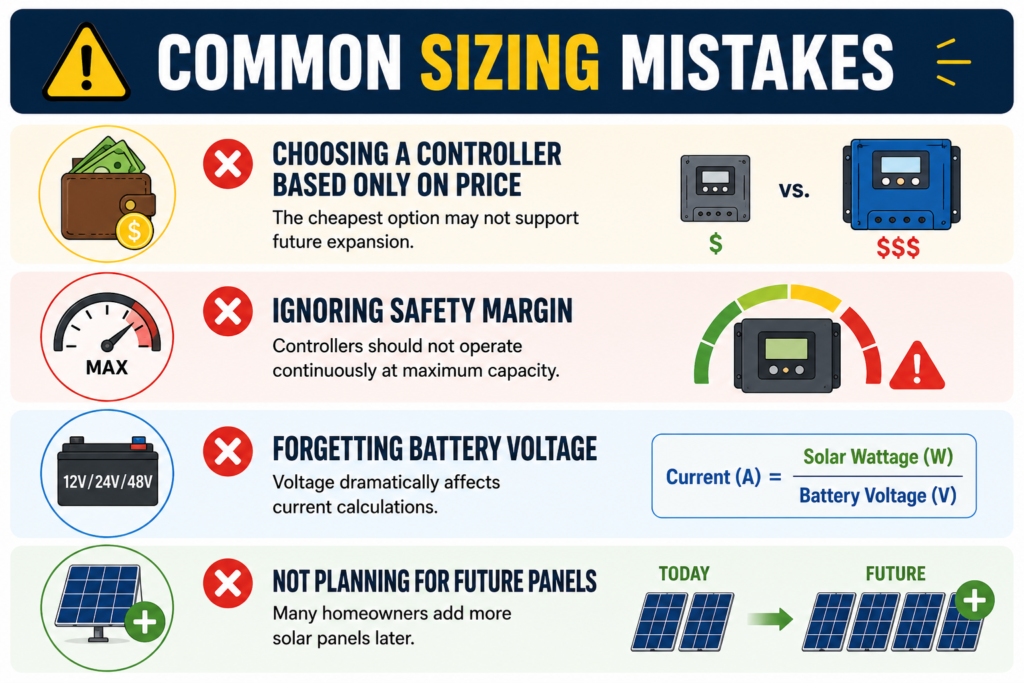
Choosing a Controller Based Only on Price
The cheapest option may not support future expansion.
Ignoring Safety Margin
Controllers should not operate continuously at maximum capacity.
Forgetting Battery Voltage
Voltage dramatically affects current calculations.
Not Planning for Future Panels
Many homeowners add more solar panels later.
A slightly larger controller can save money on future upgrades.
Should You Oversize a Charge Controller?
In most cases: Yes, slightly.
Benefits include:
- Cooler operation
- Longer lifespan
- Expansion flexibility
Oversizing by 20–30% is common practice.
Solar Charge Controller Sizing Calculator
If you don’t want to perform manual calculations, a charge controller sizing calculator can instantly determine the correct controller size based on:
- Solar panel wattage
- Battery voltage
- Safety margin
A dedicated calculator can simplify system planning and reduce sizing errors.
Should You Buy a Larger Controller for Future Solar Panels?
Many homeowners add additional panels later.
Example
Current System: 1000W
Future Expansion: 1500W
Instead of buying a 60A controller today and replacing it later, purchasing an 80A controller initially may be more cost-effective.
FAQs
What size charge controller do I need for a 1000W solar system?
For a 24V battery system: 1000 ÷ 24 = 41.7A
With a safety margin: Recommended controller size is typically 60A.
Can a charge controller be too big?
Yes, but oversized controllers generally operate safely. The main downside is higher cost.
Can a charge controller be too small?
Yes. An undersized controller may overheat, limit charging, or fail prematurely.
Should I use MPPT or PWM?
MPPT is generally recommended for most residential systems because of its higher efficiency and flexibility.
How much safety margin should I add?
A 20–25% safety margin is commonly recommended.
Do lithium batteries need larger charge controllers?
Not necessarily larger, but lithium systems often benefit from higher charging currents and MPPT technology.
Can I oversize a charge controller?
Yes. Slight oversizing is common and often beneficial.
Can I use a 30A controller with a 1000W solar array?
Usually not for a 12V system. The controller may become overloaded.
Does battery voltage affect controller size?
Yes. Higher battery voltages reduce charging current requirements, which often allows smaller controller amperage ratings.
Final Thoughts
Choosing the correct solar charge controller size is essential for safe and efficient battery charging.
The sizing process is straightforward:
- Calculate solar panel wattage.
- Divide by battery voltage.
- Add a 25% safety margin.
- Select the next available controller size.
A properly sized charge controller helps maximize solar energy production, protect batteries, and ensure reliable long-term system performance.
If you’re planning a new solar installation, consider using a Solar Charge Controller Sizing Calculator to simplify the process and avoid costly mistakes.
