
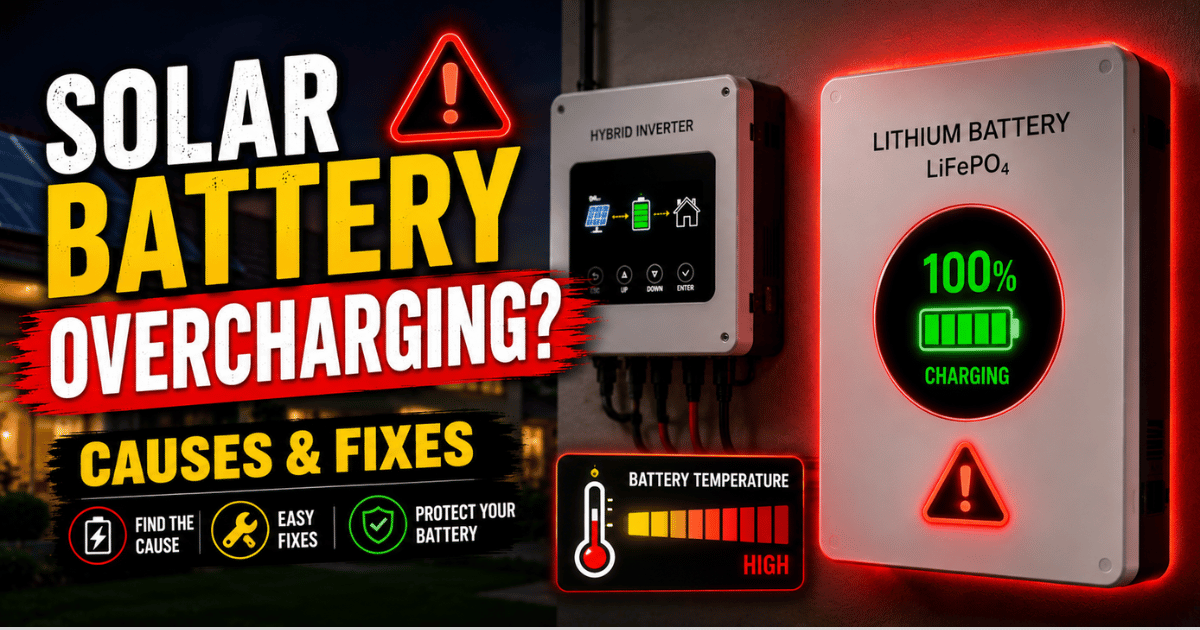

Solar batteries are designed to store excess solar energy safely and efficiently. However, when a battery receives more charge than it can safely handle, overcharging can occur. Solar battery overcharging is a serious issue because it can:
- Reduce battery lifespan
- Cause overheating
- Damage battery cells
- Reduce system efficiency
- Create safety risks
The good news?
Modern solar systems include protection mechanisms that help prevent overcharging. However, equipment failures, incorrect settings, and wiring problems can still cause batteries to charge beyond safe limits.
In this guide, you’ll learn:
- What solar battery overcharging is
- Common warning signs
- Causes of overcharging
- Real-world examples
- Troubleshooting steps
- How to prevent future problems
Quick Answer
A solar battery may overcharge because of:
- Faulty charge controller
- Incorrect inverter settings
- Battery management system (BMS) failure
- Wiring issues
- Faulty sensors
- Incorrect battery type configuration
Overcharging should be addressed quickly because it can shorten battery life and potentially damage the battery.
What Is Solar Battery Overcharging?
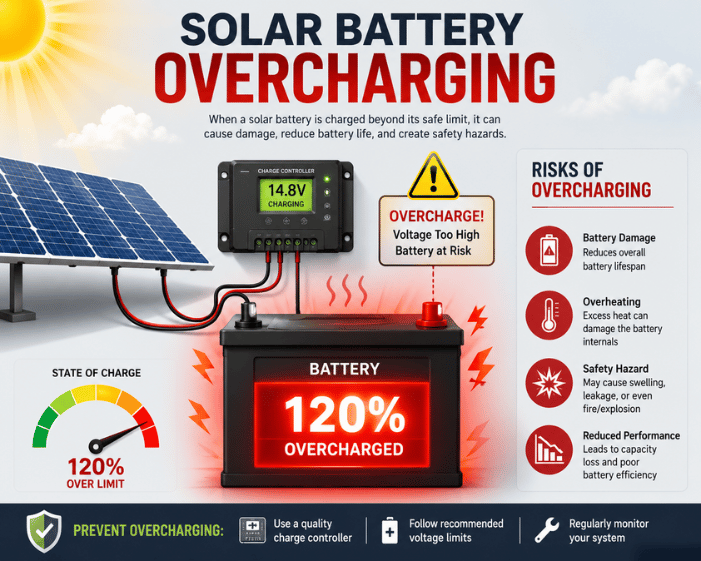
Overcharging occurs when a battery continues receiving charging current after reaching its recommended charge level. Every battery has a safe charging range.
When charging exceeds this range:
👉 Internal battery temperatures may rise.
👉 Battery chemistry may become unstable.
👉 Long-term battery degradation can accelerate.
Warning Signs of Solar Battery Overcharging
Common symptoms include:
- Battery overheating
- Swollen battery casing
- Unusual battery odor
- Rapid battery degradation
- Battery voltage remaining unusually high
- Frequent inverter warnings
- Reduced battery lifespan
Why Battery Overcharging Is Dangerous
Overcharging can affect:
- Battery capacity
- Internal battery components
- Battery safety
- Overall solar system reliability
In severe cases, overcharging can permanently damage battery cells.
Causes for Solar Battery Overcharging
1. Faulty Charge Controller (Most Common Cause)
The charge controller regulates how much energy flows into the battery.
If it fails:
👉 Charging may continue beyond safe limits.
Symptoms
- Constant charging
- High battery voltage
- Battery overheating
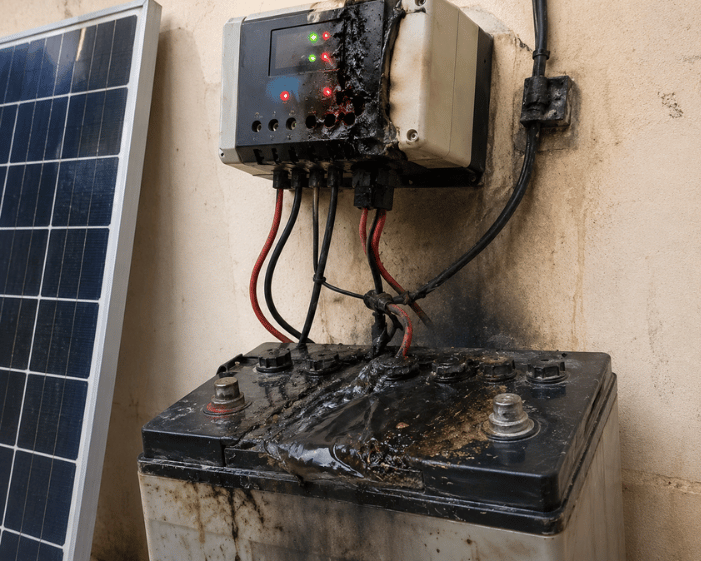
Real Example
Problem: Battery remained at elevated voltage all day.
Cause: Faulty charge controller.
Solution: Controller replacement.
Result: Charging returned to normal.
2. Incorrect Inverter Settings
Modern hybrid inverters manage battery charging.
Incorrect settings can cause:
- Excessive charging voltage
- Improper charging profiles
- Charging mismatches
Common Mistakes
- Selecting lead-acid settings for lithium batteries
- Incorrect charging limits
- Wrong battery type configuration
3. Battery Management System (BMS) Failure
Lithium batteries rely on a Battery Management System (BMS).
The BMS monitors:
- Voltage
- Temperature
- Charging current
If the BMS fails: Overcharging protection may not function correctly.
Symptoms
- Rapid voltage fluctuations
- Unexpected charging behavior
- Battery communication errors
4. Incorrect Battery Type Selection
Different batteries require different charging profiles.
Example
Lithium Battery configured as: Lead-Acid Battery
Result: Charging voltage may exceed recommended levels. This can reduce battery lifespan significantly.
5. Faulty Voltage Sensors
Many charging systems rely on voltage measurements.
If a sensor fails: The system may incorrectly assume the battery still requires charging.
Symptoms
- Inaccurate battery percentage readings
- Unusual charging cycles
- Battery charging after reaching full capacity
6. Wiring Problems
Loose or damaged wiring can interfere with charging regulation.
Possible issues include:
- Incorrect voltage readings
- Controller errors
- Charging instability
Real Example
Problem: Battery charging appeared inconsistent.
Cause: Loose battery connection.
Solution: Terminal tightening and wiring inspection.
Result: Charging stabilized.
7. High Temperature Increases Risk
Heat affects battery charging behavior.
High temperatures can:
- Increase internal battery stress
- Accelerate degradation
- Reduce charging efficiency
Real Example
Battery installed in enclosed utility room.
Average temperature: 40°C+
Result: Charging issues and accelerated battery aging.
Lithium vs Lead-Acid Overcharging Risk
Different battery technologies respond differently.
| Feature | Lithium Battery | Lead-Acid Battery |
|---|---|---|
| Overcharge Protection | Advanced BMS | Limited |
| Maintenance | Low | Moderate |
| Heat Sensitivity | Moderate | High |
| Recovery From Overcharge | Better | Often Poorer |
Modern lithium batteries generally include better overcharge protection.
Related Guide: Lithium vs Lead Acid Solar Battery
How Different Battery Types React to Overcharging
Lead-Acid Batteries
Common symptoms:
- Excessive gassing
- Water loss
- Corrosion
- Bulging battery case
Lithium Batteries
Common symptoms:
- BMS shutdown
- High-voltage alarms
- Swelling
- Rapid capacity loss
Most modern lithium batteries include a BMS specifically designed to protect against overcharging.
Can Solar Panels Overcharge a Battery?
Modern solar systems are designed to prevent battery overcharging.
Normally, the following components prevent excess charging:
- Solar charge controller
- Hybrid inverter
- Battery Management System (BMS)
However, if one of these components fails or is configured incorrectly, overcharging can still occur. Charge controllers are specifically designed to limit charging current and prevent overcharging.
Real Example
Problem: Battery continued charging after reaching full capacity.
Cause: Faulty charge controller.
Result: Battery temperature increased significantly.
Real-World Overcharging Scenarios
Case 1: Faulty Charge Controller
Problem: Battery overheating daily.
Cause: Charge controller failure.
Solution: Controller replacement.
Result: Battery temperatures normalized.
Case 2: Incorrect Battery Settings
Problem: New lithium battery showed charging warnings.
Cause: Lead-acid charging profile enabled.
Solution: Updated inverter settings.
Result: Proper charging restored.
Case 3: Sensor Failure
Problem: Battery remained in charging mode continuously.
Cause: Faulty voltage sensor.
Solution: Sensor replacement.
Result: Normal charging operation resumed.
How to Troubleshoot Solar Battery Overcharging
Step 1: Check Battery Voltage
Monitor:
- Charging voltage
- Battery percentage
- Charging status
Step 2: Inspect Battery Temperature
Look for:
- Excessive heat
- Swelling
- Unusual smells
Step 3: Verify Battery Type Settings
Ensure:
- Correct battery chemistry selected
- Proper charging profile enabled
Step 4: Inspect Charge Controller
Check for:
- Fault codes
- Abnormal behavior
- Voltage irregularities
Step 5: Review Inverter Warnings
Look for:
- Charging faults
- Battery communication errors
- Voltage warnings
How to Prevent Solar Battery Overcharging
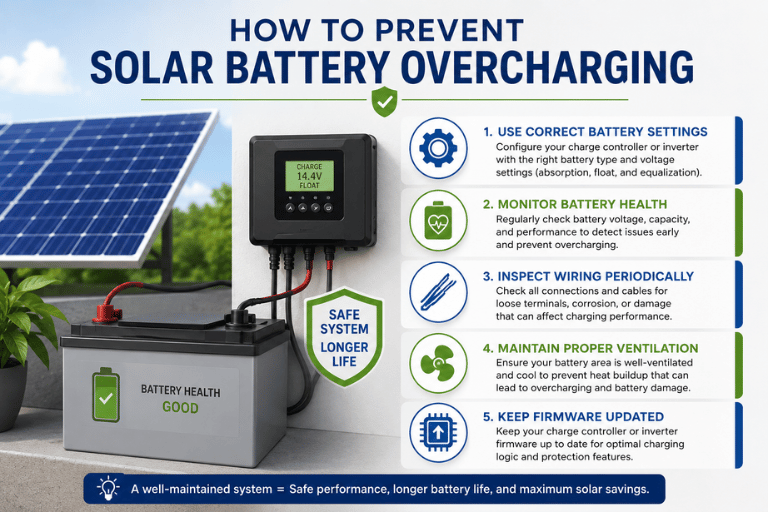
Use Correct Battery Settings
Match inverter settings to battery type.
Monitor Battery Health
Review battery performance regularly.
Inspect Wiring Periodically
Loose connections can create charging issues.
Maintain Proper Ventilation
Reduce heat-related battery stress.
Keep Firmware Updated
Manufacturers often release updates that improve charging management.
What Happens When a Battery Is Overcharged?
Overcharging creates unwanted chemical reactions inside the battery.
Potential effects include:
- Excessive heat generation
- Capacity loss
- Cell imbalance
- Internal pressure buildup
- Shortened battery lifespan
For lithium batteries, severe overcharging can trigger thermal runaway, while lead-acid batteries may experience gassing, water loss, and plate corrosion.
Can Battery Overcharging Affect Warranty Coverage?
Potentially, yes. Many battery manufacturers require:
- Correct inverter settings
- Approved charging equipment
- Proper installation
Damage caused by incorrect charging settings or unsupported equipment may not be covered under warranty.
Example
Battery installed correctly: Covered
Battery repeatedly overcharged because of incorrect settings: May not qualify for warranty replacement
Does One Overcharge Event Damage a Battery?
Not always. The severity depends on:
- Battery chemistry
- Charging voltage
- Duration of overcharging
- Battery temperature
A brief over-voltage event may cause little damage, while repeated overcharging can significantly reduce battery lifespan and capacity.
How to Detect Battery Overcharging Early
Modern monitoring systems can provide early warning signs.
Watch for:
- High-voltage alerts
- Unusual temperature increases
- Continuous charging after 100%
- Frequent BMS warnings
- Rapid battery degradation
Persistent high-voltage alarms and overheating are common warning indicators of charging problems.
When Should You Call a Technician?
Professional assistance is recommended if:
- Battery overheats repeatedly
- Swelling is visible
- Strong odors develop
- Faults continue after troubleshooting
- BMS errors appear frequently
FAQs
Can solar batteries be overcharged?
Yes. Although modern systems include protection mechanisms, equipment failures and incorrect settings can still cause overcharging.
What happens if a solar battery is overcharged?
Possible consequences include:
- Overheating
- Capacity loss
- Reduced lifespan
- Cell damage
Are lithium batteries protected against overcharging?
Most lithium batteries include Battery Management Systems (BMS) that provide overcharge protection.
Can a faulty charge controller cause overcharging?
Yes. Charge controller failure is one of the most common causes of battery overcharging.
How do I know if my battery is overcharging?
Warning signs include:
- High battery voltage
- Excessive heat
- Swelling
- Unusual charging behavior
Is battery overcharging dangerous?
It can be. Overcharging may reduce battery lifespan and, in severe cases, create safety concerns.
Can an MPPT charge controller prevent battery overcharging?
Yes. Properly configured MPPT charge controllers are designed to regulate charging voltage and help prevent battery overcharging.
Can overcharging reduce battery lifespan?
Yes. Repeated overcharging can accelerate degradation, reduce capacity, and shorten the battery’s useful life.
What is the most common cause of solar battery overcharging?
Faulty charge controllers, incorrect inverter settings, and battery management system issues are among the most common causes
Final Thoughts
Solar battery overcharging is a serious issue that should never be ignored.
The most common causes include:
- Faulty charge controllers
- Incorrect inverter settings
- BMS failures
- Wiring problems
Regular monitoring, proper system configuration, and routine maintenance can prevent most overcharging issues and significantly extend battery lifespan.
If you’re planning to upgrade your battery system, compare battery technologies carefully and ensure your inverter settings match the battery chemistry being used.
