

As solar technology evolves, more homeowners are choosing hybrid solar inverters for better energy management and backup power. But what exactly is a hybrid inverter? And is it worth the extra cost compared to a normal solar inverter?
A hybrid solar inverter combines solar power generation, battery storage, and grid management into one system, allowing homes to use solar energy day and night while providing backup during outages.
In this complete 2026 guide, you’ll learn:
- What a hybrid solar inverter is
- How it works
- Real-world examples
- Pros and cons
- Hybrid vs normal inverter comparison
- Whether a hybrid inverter is right for your home
Quick Answer
👉 A hybrid solar inverter combines:
- Solar inverter
- Battery inverter
- Charge controller
into a single system.
👉 It allows you to:
- Use solar power
- Store energy in batteries
- Use grid electricity when needed
- Get backup power during outages
What Is a Hybrid Solar Inverter?
A hybrid solar inverter is an advanced inverter that manages:
- Solar panels
- Battery storage
- Grid connection
all together.
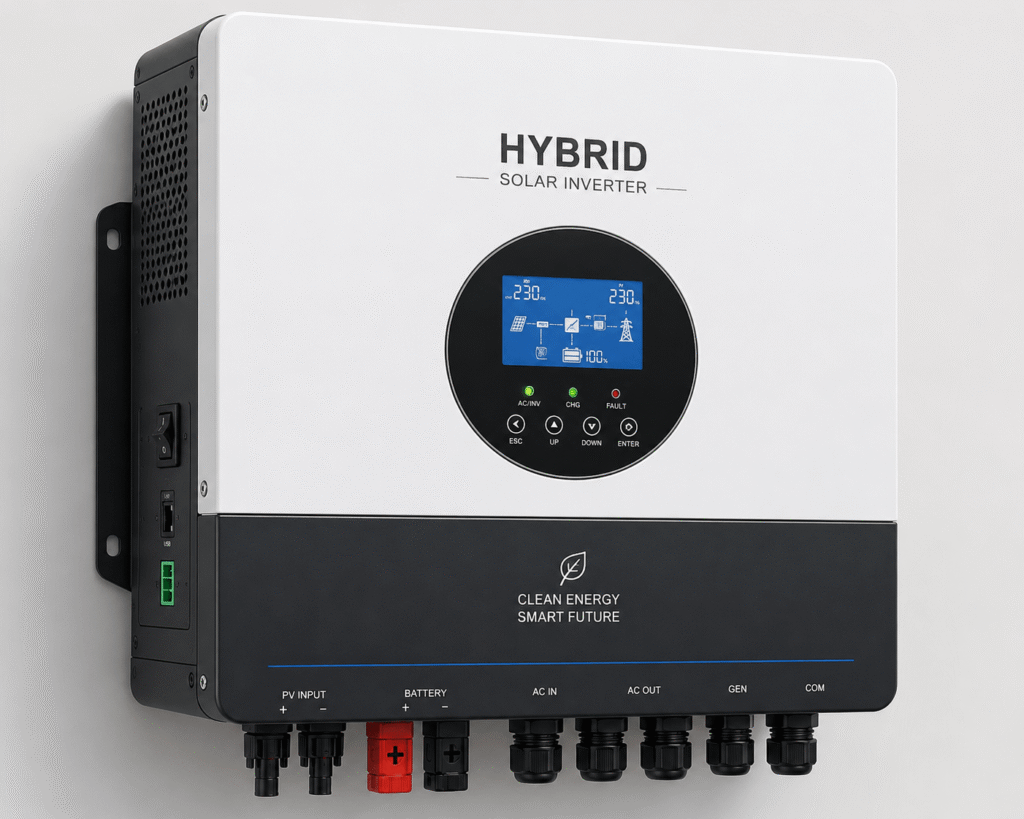
Unlike traditional solar inverters: Hybrid inverters can store excess solar energy in batteries for later use.
How Hybrid Solar Inverter Works
During Daytime
- Solar panels generate electricity
- Home uses solar power first
- Extra power charges the battery
During Nighttime
- Battery powers the home
- Grid electricity used only if battery becomes low
During Power Outage
👉 Hybrid inverter switches to battery backup automatically.
Hybrid Inverter vs Normal Inverter
| Feature | Normal Inverter | Hybrid Inverter |
|---|---|---|
| Battery support | Limited | Yes |
| Backup during outage | Usually no | Yes |
| Solar + battery integration | Separate devices | Integrated |
| Energy storage | No | Yes |
| Cost | Lower | Higher |
| Smart energy management | Basic | Advanced |
Why Hybrid Inverters Are Becoming Popular
Rising electricity costs and frequent outages are increasing demand for energy independence.
👉 Hybrid systems help homeowners:
- Reduce electricity bills
- Store excess solar energy
- Improve backup reliability
- Reduce dependence on grid power
Real-World Example
Example: Typical Residential Hybrid System
System:
- 5 kW solar panels
- 10 kWh lithium battery
- Hybrid inverter
Daytime
- Home runs on solar
- Battery charges
Nighttime
- Battery powers essential appliances
Power Outage
- Battery backup activates automatically
👉 Result: Lower electricity bills + backup power.
What Happens During a Power Outage?
A standard grid-tied inverter usually shuts down during blackouts.
👉 But a hybrid inverter with battery backup can continue powering essential appliances.
Example:
- Lights
- Fans
- Refrigerator
- Wi-Fi
👉 This is one of the biggest advantages of hybrid systems.
Hybrid Inverter with Battery Storage
One major advantage of hybrid systems: Battery integration.
Benefits of Battery Storage
- Backup during outages
- Better solar utilization
- Reduced grid dependency
- Lower electricity bills
Related guide: Solar Battery draining fast
Can a Hybrid Inverter Work Without Battery?
Yes. Most hybrid inverters can operate without batteries initially.
This allows homeowners to:
- Install solar first
- Add battery storage later
This flexibility is one reason hybrid inverters are becoming very popular.
Understanding Surge Load in Hybrid Inverters
Some appliances require extra startup power.
Examples:
- Air conditioners
- Water pumps
- Refrigerators
👉 Hybrid inverters must be sized properly to handle both:
- Continuous load
- Surge load
Hybrid Inverter vs String Inverter
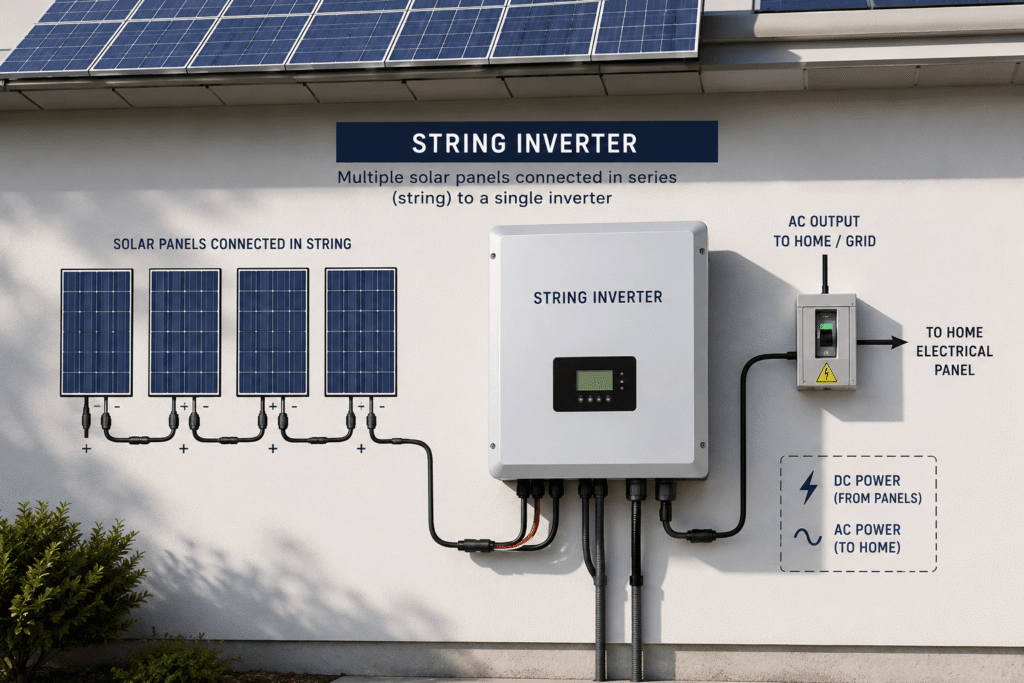
String Inverter
- Converts solar power only
- No battery intelligence
- Simpler and cheaper
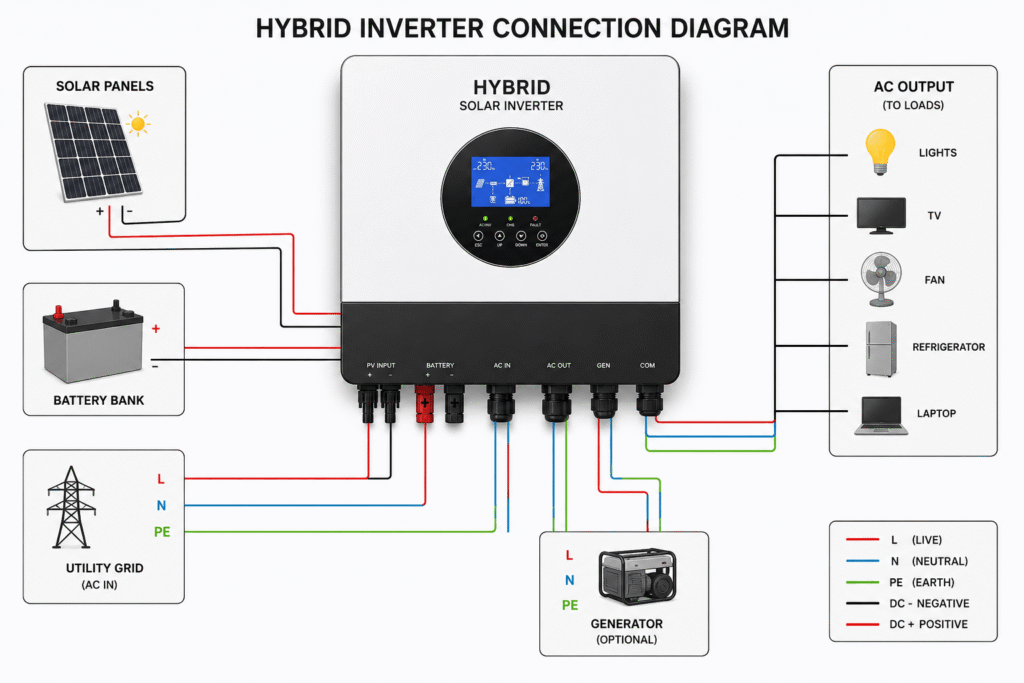
Hybrid Inverter
- Manages solar + battery + grid
- More advanced energy control
Learn more: String Inverter vs Microinverter
Hybrid Inverter Efficiency
Modern hybrid inverters are highly efficient.
Typical efficiency:
- 95–98%
Factors Affecting Efficiency
- Battery type
- Load management
- Solar production
- Temperature
- System sizing
Learn more: Solar Panel efficiency
Real Backup Time Example
Battery: 10 kWh lithium battery
Nighttime usage:
- Lights → 300W
- Fans → 300W
- Refrigerator → 200W
👉 Total load: 800W
👉 Estimated backup: Around 10–12 hours
Best Battery Types for Hybrid Systems
Lithium-Ion Batteries
Most popular choice.
Advantages:
- Long lifespan
- High efficiency
- Faster charging
- Lower maintenance
Lead-Acid Batteries
Lower upfront cost.
Disadvantages:
- Shorter lifespan
- More maintenance
- Lower efficiency
Lithium vs Lead-Acid Comparison
| Feature | Lithium | Lead-Acid |
|---|---|---|
| Lifespan | Longer | Shorter |
| Maintenance | Low | Higher |
| Efficiency | Higher | Lower |
| Weight | Lighter | Heavier |
AC-Coupled vs DC-Coupled Hybrid Systems
DC-Coupled Systems
- Solar charges battery directly
- Higher efficiency
- Simpler energy flow
AC-Coupled Systems
- Easier for retrofitting existing solar systems
- More flexible expansion
👉 DC-coupled systems are common in new installations, while AC-coupled systems are popular for upgrades.
Real-World Use Cases
Case 1: Home With Frequent Power Cuts
Problem: Frequent outages affecting daily life.
Solution: Hybrid inverter + battery backup.
👉 Result: Automatic backup during outages.
Case 2: High Electricity Bills
Problem: Heavy evening power consumption.
Solution: Use stored battery energy at night.
👉 Result: Reduced grid electricity usage.
Case 3: Remote Area with Weak Grid
Problem: Unstable utility supply.
Solution: Hybrid system with larger battery storage.
👉 Result: More reliable electricity.
Common Hybrid Inverter Installation Mistakes
Common mistakes include:
- Improper inverter sizing
- Poor ventilation
- Incorrect battery configuration
- Using incompatible batteries
👉 Proper installation is critical for efficiency and long-term reliability.
Hybrid Inverter and ROI
Hybrid systems cost more initially.
However: Long-term savings may improve because:
- More solar energy is utilized
- Less grid electricity is purchased
- Backup power value increases
Learn more: Solar Panel ROI
Hybrid Inverter Cost
Hybrid systems are generally more expensive than standard solar systems.
Main Cost Factors
- Inverter size
- Battery capacity
- Battery type
- Installation complexity
👉 However: Prices are gradually decreasing as adoption increases.
Common Problems with Hybrid Inverters
Battery Issues
- Fast draining
- Improper charging
- Aging batteries
Inverter Errors
- Overload
- Fault codes
- Communication errors
Overheating
Poor ventilation may reduce efficiency.
When a Hybrid Inverter May Not Be Worth It
A hybrid inverter may not be necessary if:
- Grid power is highly reliable
- No battery backup is needed
- Electricity bills are already low
👉 In such cases, a standard grid-tied inverter may be more cost-effective.
Hybrid Inverter Maintenance Tips
Monitor Battery Health
Track:
- Charging cycles
- Backup time
- Battery temperature
Clean Solar Panels Regularly
Regularly cleaning the solar panel Improves charging efficiency.
Avoid Overloading the System
Heavy loads reduce backup time.
Keep Inverter Ventilated
Heat affects efficiency and lifespan.
Hybrid vs Off-Grid Solar System
| Feature | Hybrid System | Off-Grid System |
|---|---|---|
| Grid connection | Yes | No |
| Battery backup | Yes | Yes |
| Grid dependency | Partial | None |
| Reliability | High | Depends on battery size |
Who Should Buy a Hybrid Solar Inverter?
Hybrid inverters are ideal for:
- Homes with frequent power cuts
- Users wanting battery backup
- People seeking lower electricity bills
- Homes planning future battery upgrades
When Hybrid Inverter May Not Be Necessary
You may not need a hybrid inverter if:
- Grid power is very reliable
- No battery backup needed
- Budget is limited
Hybrid Inverter Pros & Cons
| Pros | Cons |
|---|---|
| Battery backup | Higher cost |
| Better energy management | More complex |
| Lower grid dependency | Battery replacement cost |
| Smart monitoring | Higher upfront investment |
Expert Insight
From real installations:
- Hybrid systems are becoming increasingly popular
- Lithium batteries pair best with hybrid inverters
- Proper system sizing is critical for good backup performance
Future of Hybrid Solar Systems
Hybrid systems are becoming increasingly popular because:
- Battery prices are decreasing
- Electricity prices are increasing
- Smart energy management is improving
👉 Many modern solar installations are now designed to support future battery expansion.
FAQs
What is a hybrid solar inverter?
A hybrid inverter manages solar panels, batteries, and grid electricity together.
Can hybrid inverter work without battery?
Yes, many hybrid inverters can operate without batteries initially.
Are hybrid inverters worth it?
Yes — especially in areas with power outages or high electricity costs.
Which battery is best for hybrid inverter?
Lithium-ion batteries are generally the best choice.
Can hybrid inverter power entire home?
Depends on inverter size and battery capacity.
Final Thoughts
Hybrid solar inverters combine:
- Solar generation
- Battery storage
- Smart energy management
into one efficient system.
👉 They are ideal for homeowners seeking:
- Energy independence
- Backup power
- Better long-term savings
As battery technology improves, hybrid systems are becoming one of the most attractive residential solar solutions.
Before choosing a hybrid system:
👉 Use our solar calculator to estimate your solar production, battery size, and savings accurately.
