
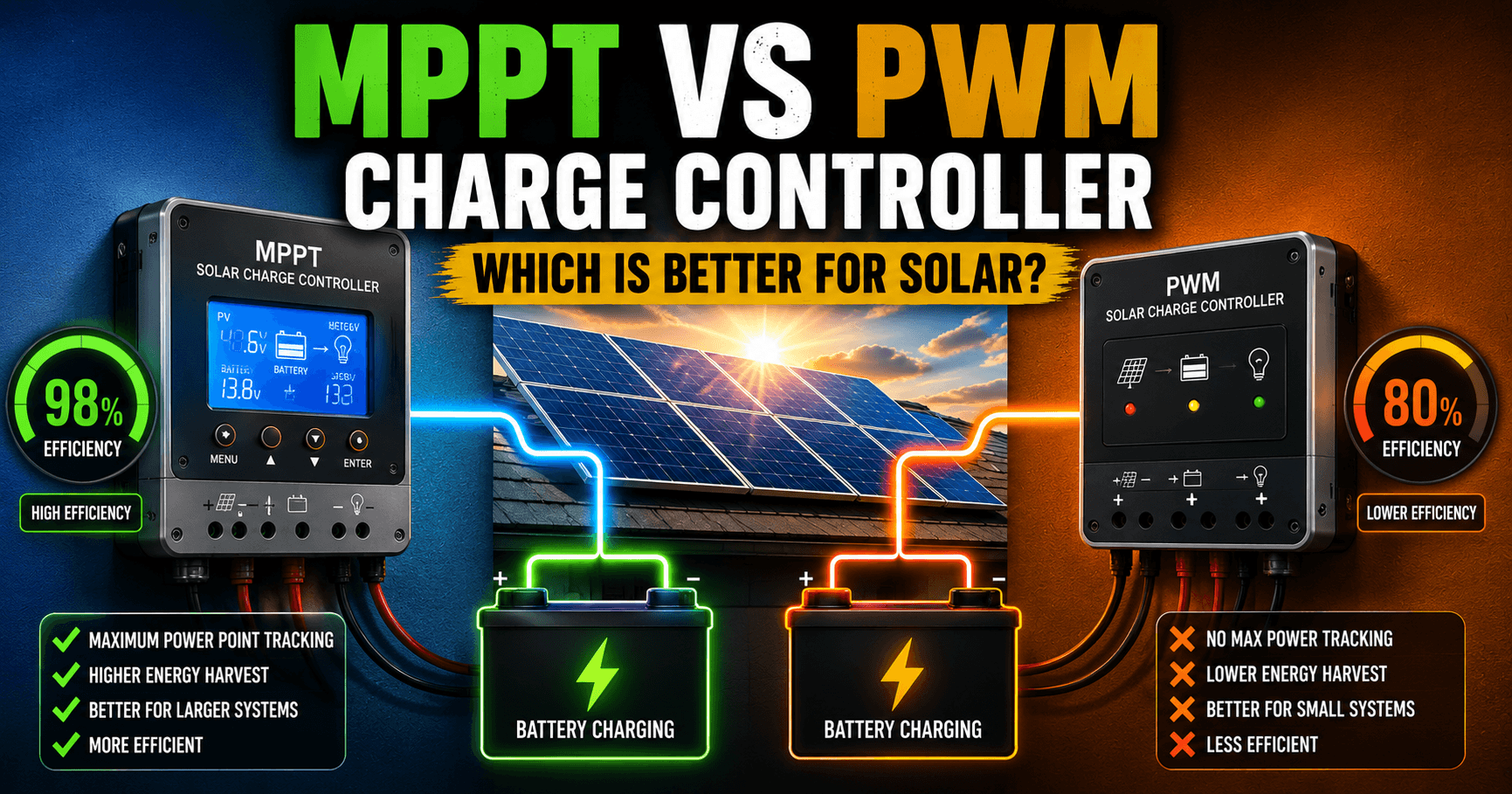

A solar charge controller is one of the most important components in a solar power system. Its job is to regulate the electricity flowing from the solar panels to the battery, preventing overcharging and improving battery performance. When shopping for a charge controller, you’ll usually encounter two technologies: MPPT (Maximum Power Point Tracking) and PWM (Pulse Width Modulation). In this guide MPPT vs PWM Charge Controller, we’ll compare both the charge controllers to help you select the right option for your solar setup.
Both perform the same basic function, but they differ significantly in efficiency, performance, cost, and suitability for different solar systems.
So which one should you choose? Let us dive deep.
Quick Answer
For most modern solar systems: MPPT charge controllers are usually the better choice.
They offer:
- Higher efficiency
- Better battery charging
- Improved energy harvesting
- Better performance in cold weather
PWM controllers may still be suitable for small systems with limited budgets.
What Is a Solar Charge Controller?
A charge controller sits between the solar panels and the battery.
Its primary functions include:
- Regulating charging voltage
- Preventing battery overcharging
- Protecting battery lifespan
- Improving charging efficiency
Without a charge controller, batteries can be damaged by excessive charging.
MPPT vs PWM Charge Controller
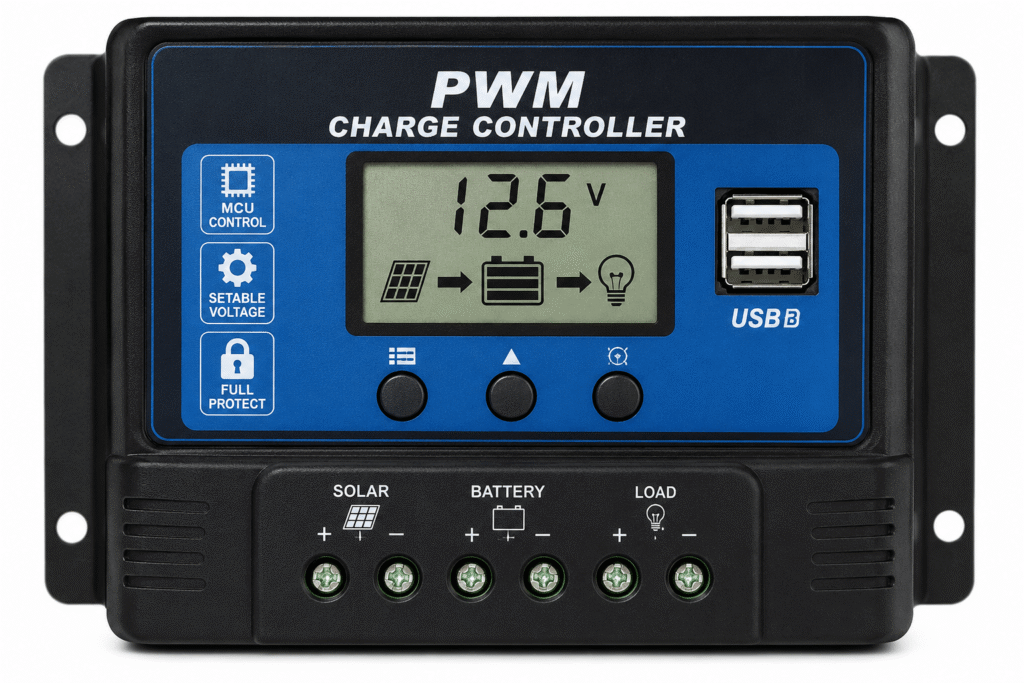
What Is a PWM Charge Controller?
PWM stands for Pulse Width Modulation.
PWM controllers work by gradually reducing the charging current as the battery approaches full charge.
Advantages of PWM Controllers
- Lower cost
- Simple design
- Reliable operation
- Suitable for small systems
Disadvantages of PWM Controllers
- Lower efficiency
- Less effective in cold weather
- Limited energy harvesting
- Not ideal for large systems
What Is an MPPT Charge Controller?
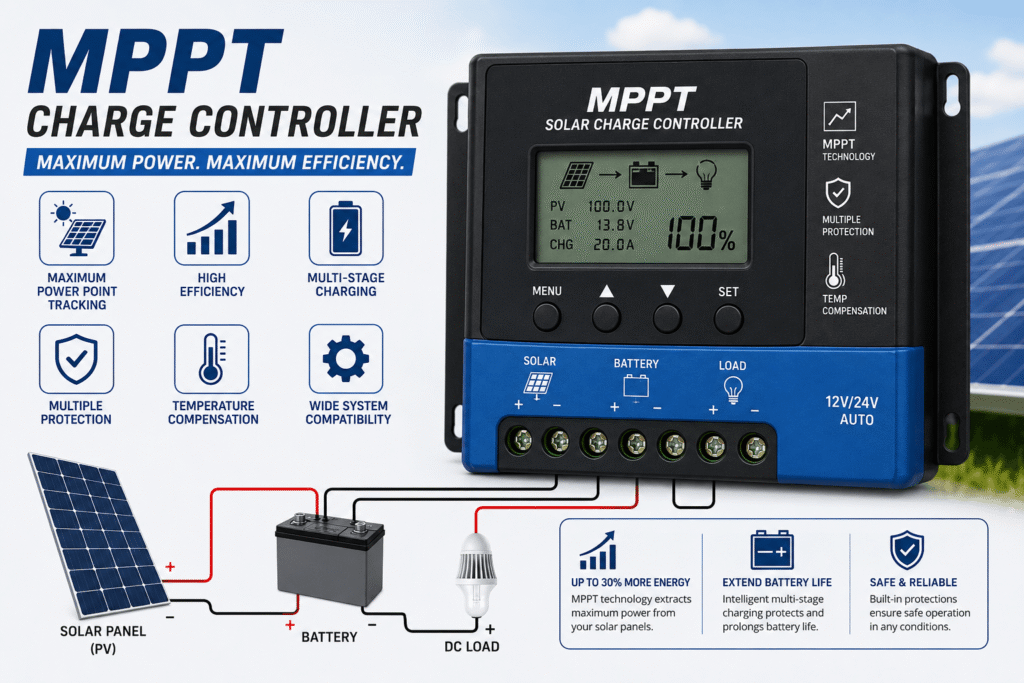
MPPT stands for Maximum Power Point Tracking.
MPPT controllers continuously adjust operating conditions to extract the maximum available power from solar panels.
Advantages of MPPT Controllers
- Higher efficiency
- Faster battery charging
- Better cold-weather performance
- Greater energy production
- Ideal for larger systems
Disadvantages of MPPT Controllers
- Higher initial cost
- More complex electronics
MPPT vs PWM Charge Controller
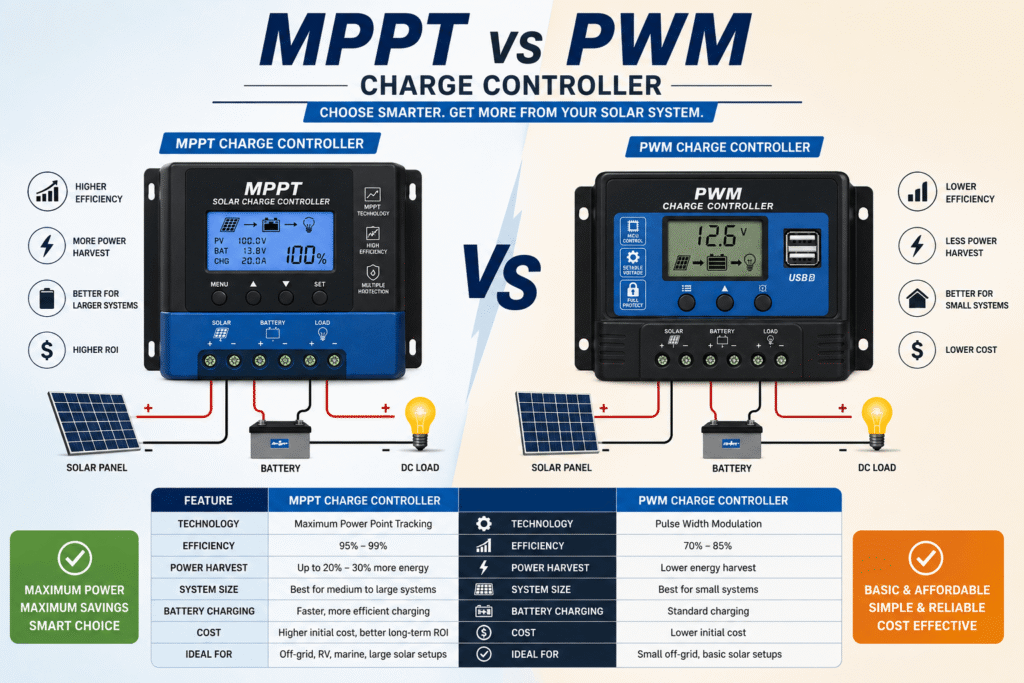
Comparison Table
| Feature | MPPT | PWM |
|---|---|---|
| Efficiency | 95–99% | 70–85% |
| Cost | Higher | Lower |
| Charging Speed | Faster | Slower |
| Energy Harvesting | Better | Moderate |
| Cold Weather Performance | Excellent | Good |
| Large Systems | Excellent | Limited |
| Small Systems | Good | Good |
| Battery Charging | Superior | Basic |
MPPT vs PWM Charge Controller: In depth comparison
1. Efficiency Comparison
Efficiency is often the biggest difference.
PWM Example
Solar panel output: 300W
Battery voltage mismatch: Some energy is lost.
Actual usable power: Lower than panel rating.
MPPT Example
Solar panel output: 300W
Controller continuously optimizes output.
Result: More usable power reaches the battery.
Real Example
Solar System: 2 kW
Location: Sunny climate
MPPT controller may harvest significantly more energy over time compared to a PWM controller.
2. Performance During Cloudy Weather
Cloudy weather reduces solar production.
MPPT controllers are generally better at extracting usable energy during low-light conditions.
Real Example
Weather: Partly cloudy
PWM Controller: Lower charging performance.
MPPT Controller: Maintains better charging efficiency.
3. Performance During Cold Weather
Solar panels often produce higher voltage in colder temperatures.
MPPT controllers can utilize this extra voltage more effectively.
Result: Better energy harvest.
4. Battery Charging Comparison
Battery charging quality directly affects battery lifespan.
PWM Charging
Suitable for:
- Small batteries
- Simple installations
MPPT Charging
Better suited for:
- Larger battery banks
- Lithium batteries
- Frequent cycling
Related Guides:
Which Controller Is Better for Home Solar Systems?
For most residential installations: MPPT is the preferred option.
Reasons:
- Higher efficiency
- Better long-term performance
- Faster charging
- Improved battery health
Which Controller Is Better for Small Off-Grid Systems?
PWM controllers may still be a good choice for:
- RV systems
- Small cabins
- Tiny off-grid setups
- Budget installations
Example
Solar panel: 100W
Battery: 12V
Usage: Weekend cabin
PWM controller may provide adequate performance.
Real Cost Example
PWM System
Controller Cost: Lower
Energy Harvest: Lower
MPPT System
Controller Cost: Higher
Energy Harvest: Higher
Over many years, the additional energy harvested by an MPPT controller may offset the higher purchase cost.
MPPT vs PWM charge controllers: Common Problems
Common MPPT Controller Problems
Possible issues include:
- Communication errors
- Incorrect settings
- Firmware problems
- Sensor failures
Related Guide: Solar Charge Controller Not Working
Common PWM Controller Problems
Possible issues include:
- Reduced efficiency
- Voltage mismatch
- Slower charging
Which Controller Is Better for Lithium Batteries?
Most lithium battery systems benefit from MPPT controllers because they:
- Charge faster
- Improve charging efficiency
- Better support modern battery technologies
Related Guide: Lithium vs Lead Acid Solar Battery
MPPT vs PWM for Lithium Batteries
Lithium batteries benefit from:
- Faster charging
- Higher charging efficiency
- More precise charging control
Because of this, MPPT controllers are often preferred for lithium battery systems. MPPT controllers typically provide better charging performance and flexibility for modern battery systems.
Real-World Homeowner Scenarios
Scenario 1: Small Budget System
Best Choice: PWM
Reason: Lower upfront cost.
Scenario 2: Residential Backup System
Best Choice: MPPT
Reason: Higher efficiency and better battery charging.
Scenario 3: Large Solar Array
Best Choice: MPPT
Reason: Maximizes energy harvest.
Scenario 4: Lithium Battery System
Best Choice: MPPT
Reason: Superior charging performance.
Should You Pay More for MPPT?
One of the most common questions homeowners ask is whether the higher cost of an MPPT controller is justified.
For small solar systems:
- The performance difference may be modest.
- PWM may be sufficient.
For larger systems:
- MPPT can harvest significantly more energy over time.
- Additional energy production can offset the higher purchase cost. MPPT controllers commonly achieve higher energy harvest than PWM controllers, especially in larger systems and varying weather conditions.
Real Example
1. Solar Array: 500W
Battery Bank: 12V
Weekend Cabin
Result: PWM may be adequate.
2. Solar Array: 5kW
Daily Home Backup
Result: MPPT is usually the better investment.
MPPT vs PWM for RVs, Vans, and Cabins
PWM controllers may still make sense for:
- RV systems
- Tiny homes
- Weekend cabins
- Small 12V installations
Example
System:
- 100W panel
- 12V battery
Budget-focused setup
Result: PWM may provide sufficient performance.
For larger mobile systems, MPPT often becomes more attractive because of its efficiency advantages.
Does MPPT Generate More Electricity?
Technically, MPPT does not create additional solar energy.
Instead, it helps extract more usable power from the solar panels by continuously operating near the maximum power point.
Example
Panel Output: 18V × 5.5A = 99W
A PWM controller may only deliver a portion of that power to a 12V battery system, while an MPPT controller can convert excess voltage into additional charging current and deliver much closer to the available panel power.
Can I Upgrade from PWM to MPPT?
Many homeowners start with PWM and later upgrade.
Benefits may include:
- Faster charging
- Better battery performance
- Increased energy harvest
- Better support for future expansion
Before Upgrading
Check:
- Battery compatibility
- Solar array voltage
- Controller sizing
How Much More Energy Can MPPT Produce?
Consider two identical solar systems.
System A: PWM Controller
System B: MPPT Controller
Over time, MPPT controllers often harvest 5–30% more energy depending on system design, climate, temperature, and panel voltage configuration.
This difference becomes more noticeable in:
- Cold climates
- Larger systems
- Variable weather conditions
FAQs
Is MPPT better than PWM?
For most residential solar systems, yes. MPPT controllers typically provide higher efficiency and better energy harvest.
How much more efficient is MPPT?
MPPT controllers can be significantly more efficient depending on system design and operating conditions.
Is PWM still worth buying?
Yes. PWM controllers remain useful for smaller solar systems with limited budgets.
Which controller is best for lithium batteries?
MPPT controllers are generally preferred because they provide better charging performance.
Can I replace a PWM controller with an MPPT controller?
In many cases, yes. However, compatibility with the existing system should be verified before upgrading.
Is MPPT worth the extra cost?
For medium and large solar systems, the additional efficiency often justifies the higher initial cost.
Is MPPT always better than PWM?
Not always. For very small systems, PWM may provide adequate performance at a lower cost. MPPT generally becomes more advantageous as system size and complexity increase.
Can MPPT work with lead-acid batteries?
Yes. MPPT controllers work with both lead-acid and lithium battery systems when configured correctly.
Does MPPT work better in cloudy weather?
Generally yes. MPPT controllers are often better at maximizing energy harvest during changing sunlight conditions.
Can I use a higher-voltage solar panel with MPPT?
Yes. One major advantage of MPPT is its ability to accept panel voltages higher than battery voltage and convert that energy efficiently.
Is PWM outdated?
No. PWM controllers remain useful for small, budget-friendly solar installations, even though MPPT is generally preferred for larger systems.
Final Thoughts
Both MPPT and PWM charge controllers can effectively regulate battery charging, but they serve different needs.
PWM controllers are affordable and suitable for small systems, while MPPT controllers provide superior efficiency, faster charging, and better long-term performance.
For most modern residential solar installations, MPPT controllers are generally the preferred choice because of their ability to maximize solar energy production and improve battery charging efficiency.
