
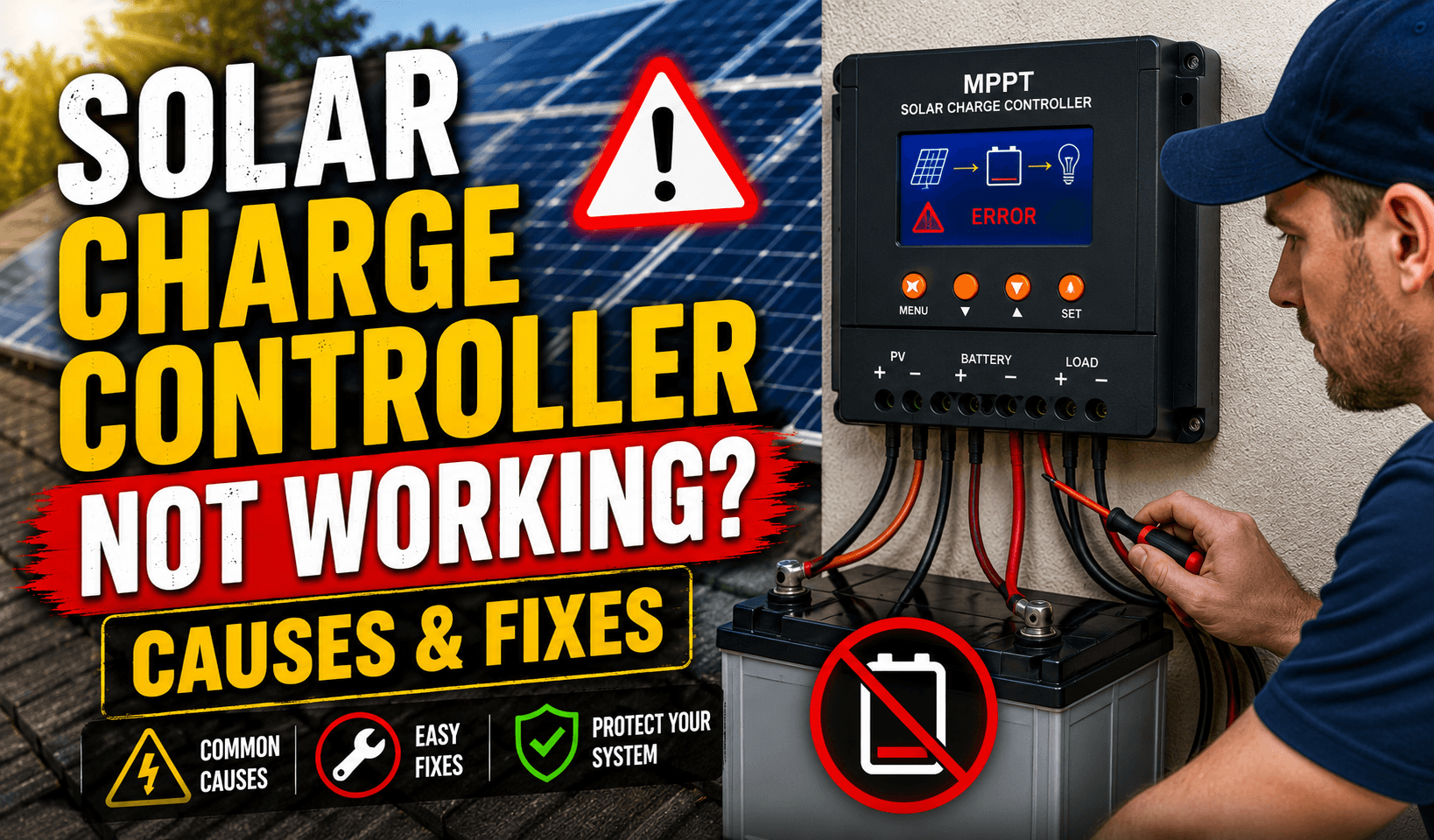

A solar charge controller is one of the most important components in a solar power system. It regulates the flow of electricity from the solar panels to the battery, ensuring the battery charges safely and efficiently. If you find the solar charge controller not working, it can cause several problems, including:
- Battery not charging
- Battery overcharging
- Reduced solar system performance
- Battery damage
- Incorrect voltage readings
The good news? Most solar charge controller problems can be diagnosed and fixed without replacing the entire solar system.
In this guide, you’ll learn:
- Common symptoms of a faulty charge controller
- Why solar charge controllers fail
- Real-world troubleshooting examples
- Step-by-step fixes
- When replacement is necessary
Quick Answer
A solar charge controller may stop working because of:
- Loose wiring
- Blown fuse
- Battery connection problems
- Incorrect settings
- Controller overheating
- Faulty sensors
- Internal component failure
Most issues can be identified by checking the controller display, battery voltage, and wiring connections.
What Does a Solar Charge Controller Do?
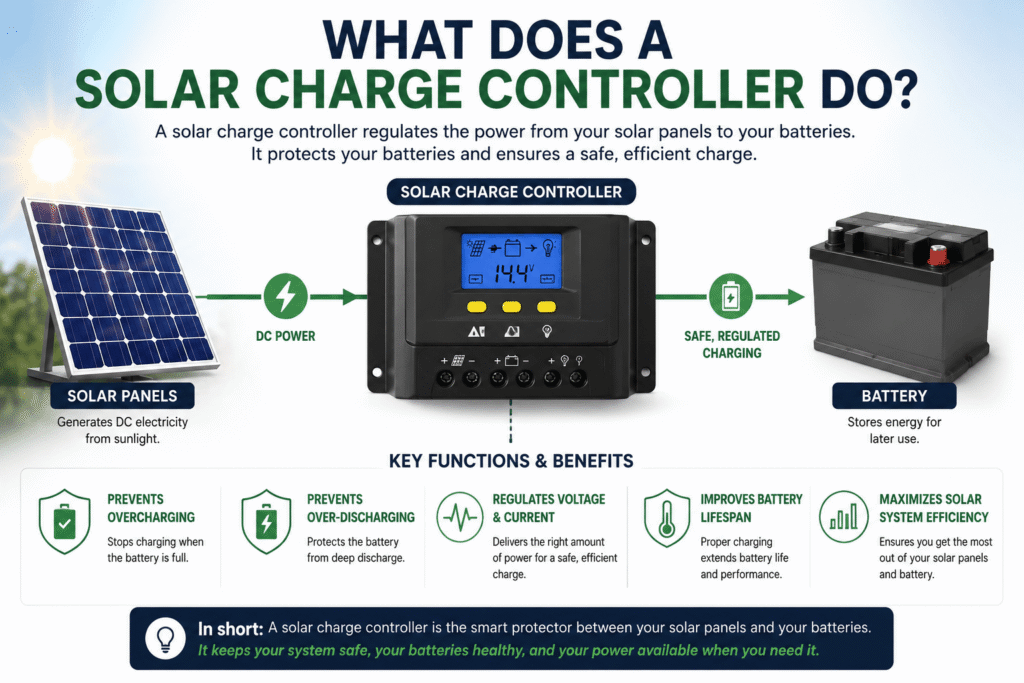
The charge controller sits between the solar panels and the battery. Its job is to:
- Regulate charging voltage
- Prevent battery overcharging
- Prevent battery over-discharge
- Protect battery health
- Improve charging efficiency
Without a properly functioning charge controller, battery life can be significantly reduced.
Signs Your Solar Charge Controller Is Not Working
Common warning signs include:
- Battery not charging
- No display on controller
- Flashing error lights
- Battery voltage unusually high
- Battery voltage unusually low
- Battery overheating
- Solar panels producing power but battery remains empty
If any of these symptoms appear, the charge controller should be inspected.
Common Causes for Solar Charge Controller Not Working
Below are the common caused for the solar charge controller not working issue:
1. Loose or Damaged Wiring
Loose wiring is one of the most common causes of charge controller problems.
Common Issues
- Corroded terminals
- Loose battery cables
- Damaged connectors
- Incorrect wiring polarity
Real Example
Problem: Battery stopped charging suddenly.
Cause: Loose positive battery cable.
Solution: Terminal tightened.
Result: Charging resumed immediately.
2. Blown Fuse or Circuit Breaker
Many solar systems include protective fuses between:
- Solar panels
- Charge controller
- Battery bank
If a fuse blows: The controller may appear dead.
Symptoms
- Blank display
- No charging current
- Battery voltage not increasing
Solution
Inspect and replace damaged fuses.
3. Battery Problems
Sometimes the controller is working correctly.
The actual issue is the battery.
Possible Battery Issues
- Battery aging
- Deep discharge damage
- Internal cell failure
- Battery not holding charge
Real Example
Problem: Controller showed charging activity. Battery remained empty.
Cause: Battery capacity severely degraded.
Solution: Battery replacement.
Result: System returned to normal.
👉 Related Guides:
4. Insufficient Solar Power
A charge controller cannot charge batteries without enough solar input.

Common Causes
- Cloudy weather
- Dirty solar panels
- Panel shading
- Damaged panels
Real Example
Problem: Battery charging extremely slowly.
Cause: Heavy dust accumulation on panels.
Solution: Solar panel cleaning.
Result: Charging performance improved significantly.
5. Charge Controller Overheating
Heat can reduce controller performance.
Common Causes
- Direct sunlight
- Poor ventilation
- Dust buildup
- Excessive charging current
Symptoms
- Reduced charging current
- Random shutdowns
- Error messages
Solution
Improve airflow and keep the controller clean.
6. Incorrect Controller Settings
Many modern controllers allow custom settings.
Incorrect configuration may cause:
- Undercharging
- Overcharging
- Charging interruptions
Common Mistakes
- Wrong battery type selected
- Incorrect charging voltage
- Improper charging profile
Real Example
Problem: Lithium battery charging poorly.
Cause: Controller configured for lead-acid batteries.
Solution: Updated settings.
Result: Normal charging restored.
7. Battery Voltage Too Low
If battery voltage falls too low, some controllers may not start charging automatically.
Symptoms
- Controller powers on
- Battery remains uncharged
- Low-voltage warnings
Solution
Battery may require recovery charging or replacement.
8. Controller Is Too Small for the System
An undersized controller may struggle to handle solar panel output.
Example
Solar Array: 4 kW
Controller: 20A
Result: Controller overheats and limits charging.
Solution
Use a properly sized controller.
Charge Controller Works During the Day but Shows Problems at Night
Many homeowners notice charging issues only after sunset.
Possible reasons include:
- Battery voltage dropping too low
- Battery communication errors
- Incorrect low-voltage disconnect settings
- Weak batteries
Real Example
Problem: Controller worked normally during daylight hours.
At night: System showed battery warnings.
Cause: Aging battery unable to maintain voltage.
Solution: Battery replacement.
Result: System operated normally again.
MPPT vs PWM Controller Problems
Different controller types behave differently.
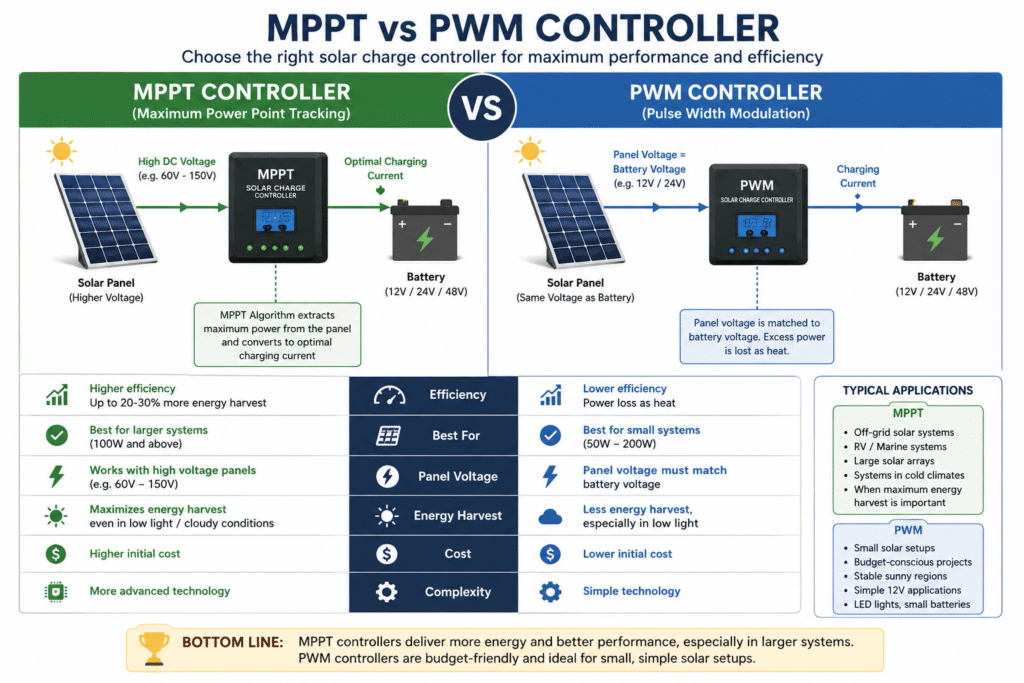
PWM Controllers
Common Issues:
- Lower efficiency
- Reduced charging performance in larger systems
MPPT Controllers
Advantages:
- Higher efficiency
- Better charging performance
- Improved energy harvesting
Charge Controller Has No Display
A blank screen is a common complaint.
Possible Causes
- Blown fuse
- No battery connection
- Internal controller failure
- Power supply issue
Troubleshooting
- Check battery voltage
- Inspect fuses
- Verify wiring connections
- Restart controller
Do MPPT and PWM Controllers Fail Differently?
PWM Controllers
Common issues:
- Reduced charging performance
- Lower efficiency
- Incorrect voltage matching
MPPT Controllers
Common issues:
- Communication errors
- Sensor faults
- Firmware issues
MPPT controllers are generally more efficient but can have more advanced troubleshooting requirements.
Real-World Troubleshooting Examples
Case 1: Controller Not Charging Battery
Problem: Battery remained at 30%.
Cause: Dirty panels reducing solar production.
Solution: Panel cleaning.
Result: Battery reached full charge again.
Case 2: Controller Showing Error
Problem: Charging stopped every afternoon.
Cause: Controller overheating.
Solution: Improved ventilation.
Result: Stable charging restored.
Case 3: New Battery Not Charging
Problem: Recently installed lithium battery would not charge.
Cause: Incorrect controller settings.
Solution: Updated battery profile.
Result: Charging normalized.
Battery Shows Full but Backup Is Poor
Sometimes the controller indicates:
- 100% battery
- Full charge status
But the battery drains quickly.
Possible causes:
- Battery aging
- Calibration issues
- Internal battery damage
- Reduced capacity
Real Example
Battery displayed: 100%
Actual capacity: Less than 50% of original storage
Result: Very short backup duration.
Related article: Solar Battery Not Holding Charge
Solar Charge Controller Flashing Error Lights
Different controllers use different indicators.
Common warning lights may indicate:
- Battery fault
- Over-voltage
- Under-voltage
- Over-temperature
- Panel connection issues
Always consult the manufacturer manual for fault code meanings.
Why Is My Solar Charge Controller Hot?
Some warmth is normal.
However, excessive heat may indicate:
- Overloaded controller
- Poor ventilation
- Loose wiring
- Internal component failure
Real Example
Problem: Controller too hot to touch.
Cause: Undersized controller for solar array size.
Solution: Installed larger controller.
Result: Stable temperatures and charging performance.
How to Troubleshoot a Solar Charge Controller
- Inspect controller display.
- Check battery voltage.
- Verify solar panel voltage.
- Inspect all wiring.
- Check controller settings.
- Look for fault codes.
- Restart the system if safe to do so.
How to Prevent Charge Controller Problems
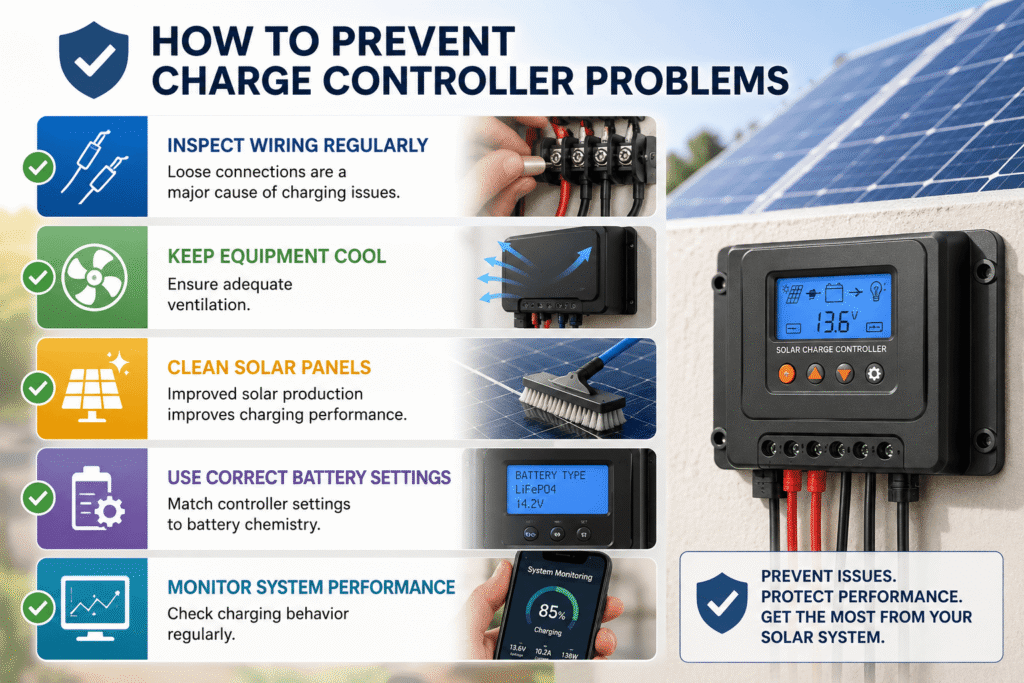
Inspect Wiring Regularly
Loose connections are a major cause of charging issues.
Keep Equipment Cool
Ensure adequate ventilation.
Clean Solar Panels
Improved solar production improves charging performance.
Use Correct Battery Settings
Match controller settings to battery chemistry.
Monitor System Performance
Check charging behavior regularly.
Can a Faulty Charge Controller Harm the Battery?
Yes. A malfunctioning controller may cause:
- Overcharging
- Undercharging
- Reduced battery lifespan
- Capacity loss
This is why charging problems should be addressed quickly.
When Should You Replace the Charge Controller?
Replacement may be necessary if:
- Display remains blank
- Charging stops permanently
- Internal components fail
- Repeated faults continue after troubleshooting
FAQs
Why is my solar charge controller not charging the battery?
Common causes include low solar input, faulty wiring, incorrect settings, battery problems, or controller failure.
How do I know if my charge controller is faulty?
Warning signs include:
- Blank display
- No charging current
- Error messages
- Battery not charging
Can a bad battery make the controller appear faulty?
Yes. A severely degraded battery can prevent normal charging and create misleading symptoms.
Can a charge controller overcharge a battery?
Yes. A faulty controller may fail to regulate charging voltage properly.
Is it safe to reset a charge controller?
In many cases, yes. Follow the manufacturer’s instructions before performing a reset.
How long does a solar charge controller last?
Most quality charge controllers can last 10 years or more when installed and maintained properly.
Should I repair or replace a faulty charge controller?
Minor issues such as loose wiring can often be repaired. Internal component failures usually require replacement.
Why is my charge controller getting hot?
Common causes include poor ventilation, oversized solar arrays, and internal faults.
Can a charge controller stop working suddenly?
Yes. Loose wiring, blown fuses, internal failures, and overheating can cause sudden failure.
Why is my charge controller showing full battery when the battery is weak?
Battery degradation or calibration issues may cause inaccurate readings.
Can a bad charge controller ruin a battery?
Yes. Improper charging can shorten battery lifespan and reduce capacity.
Final Thoughts
A faulty solar charge controller can cause battery charging issues, reduced solar performance, and even battery damage if left unresolved.
Fortunately, most charge controller problems are caused by wiring issues, incorrect settings, battery faults, or poor solar production rather than complete controller failure.
Regular maintenance, proper system sizing, and routine monitoring can prevent most charge controller problems and keep your solar system operating efficiently for years.
