
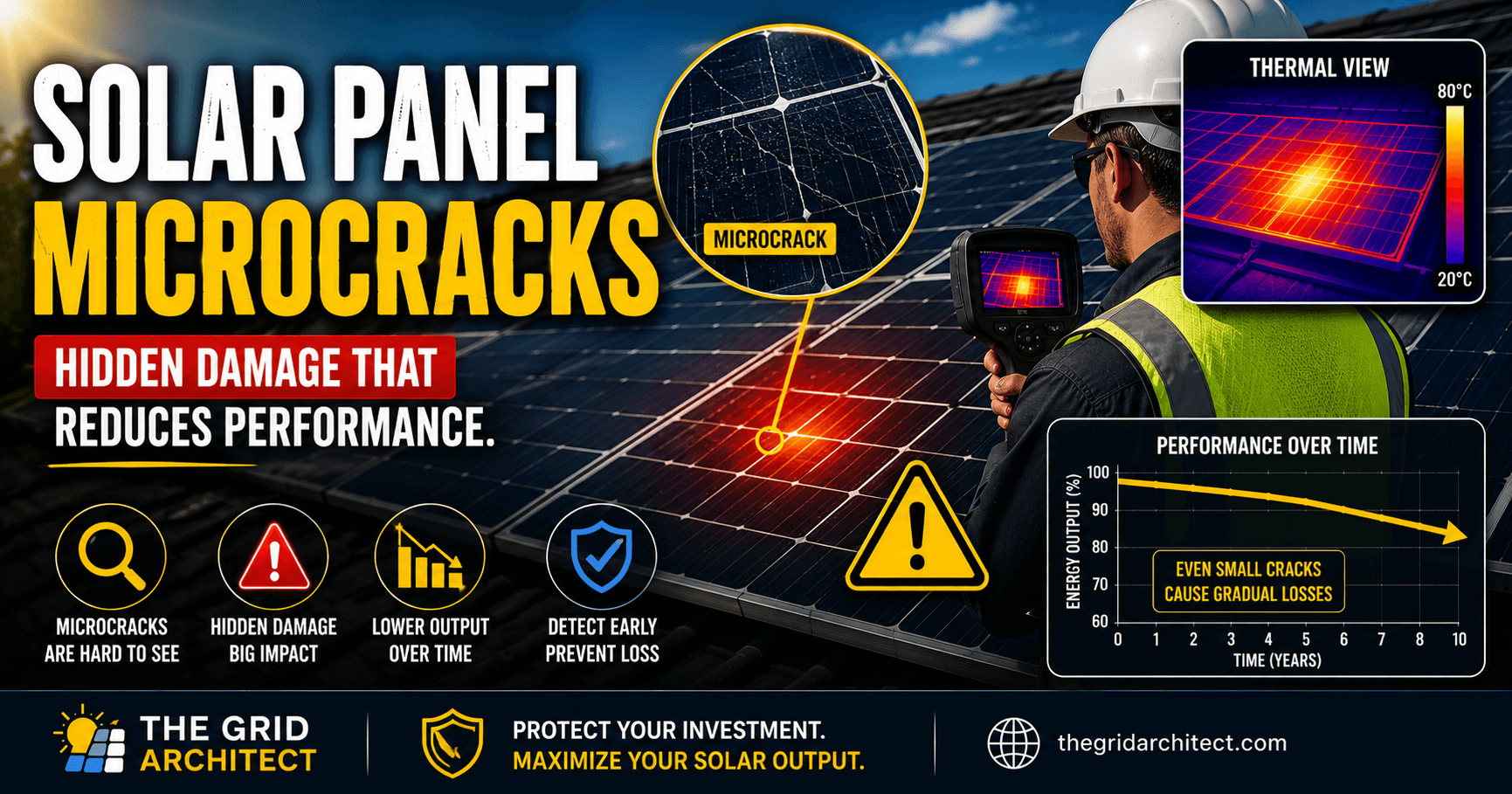

Solar panels are built to withstand decades of exposure to sunlight, weather, and temperature changes. However, even when a solar panel appears perfectly normal from the outside, hidden damage may exist inside the solar cells. One of the most common forms of hidden damage is solar panel microcracks.
Microcracks are tiny fractures within solar cells that can reduce power output, create hot spots, accelerate degradation, and shorten panel lifespan.
The challenge? Most solar panel microcracks cannot be seen with the naked eye.
In this guide, you’ll learn:
- What solar panel microcracks are
- What causes them
- How they affect solar performance
- How installers detect them
- Prevention methods
- When replacement may be necessary
Quick Answer
Solar panel microcracks are tiny fractures inside solar cells that are often invisible during normal inspections.
Common causes include:
- Transportation damage
- Improper handling
- Installation stress
- Thermal expansion and contraction
- Heavy snow loads
- Hail impacts
- Manufacturing defects
While small microcracks may have little immediate effect, severe microcracking can reduce solar production and lead to hot spots and long-term degradation.
What Are Solar Panel Microcracks?
Solar Panel microcracks are microscopic fractures that develop within the silicon solar cells inside a panel. Unlike visible cracks in the glass, microcracks occur internally.
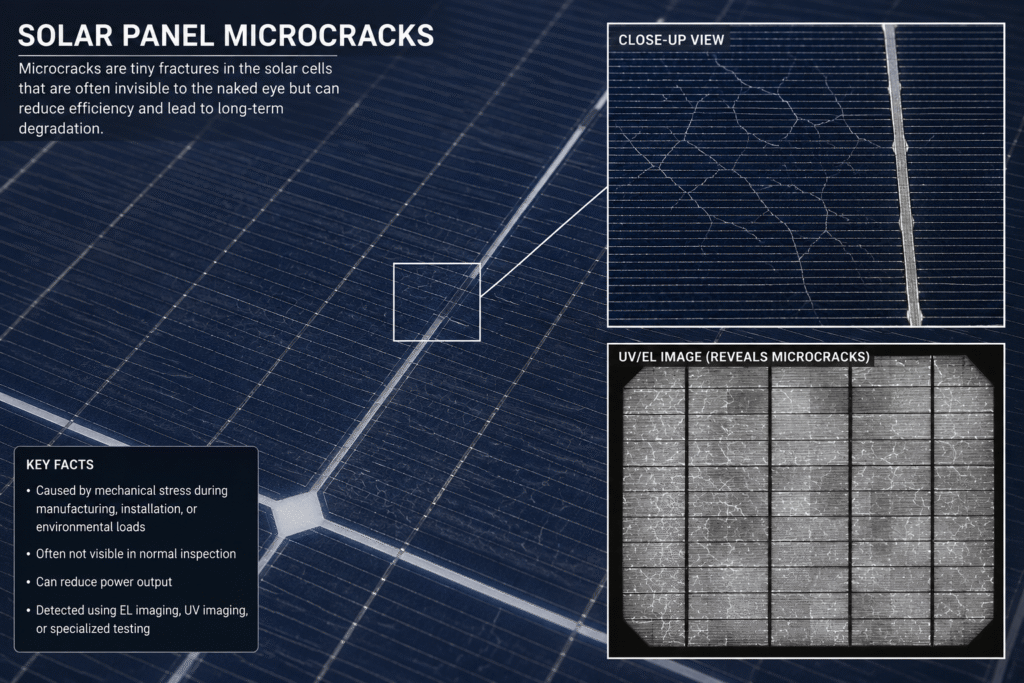
Because they are often hidden beneath the glass and encapsulation layers, they may remain undetected for years.
Why Microcracks Matter
Solar cells rely on uninterrupted electrical pathways.
When cracks develop:
- Current flow becomes restricted
- Cell efficiency decreases
- Power production drops
- Heat generation may increase
Over time, these effects can become more severe.
Signs of Solar Panel Microcracks
Microcracks rarely produce obvious visual symptoms.
However, they may cause:
- Gradual reduction in solar output
- Unexplained performance losses
- Hot spots
- Uneven panel performance
- Accelerated degradation
- Increased cell temperatures
Many homeowners first notice microcracks through monitoring data rather than visual inspection.
What Causes Solar Panel Microcracks?
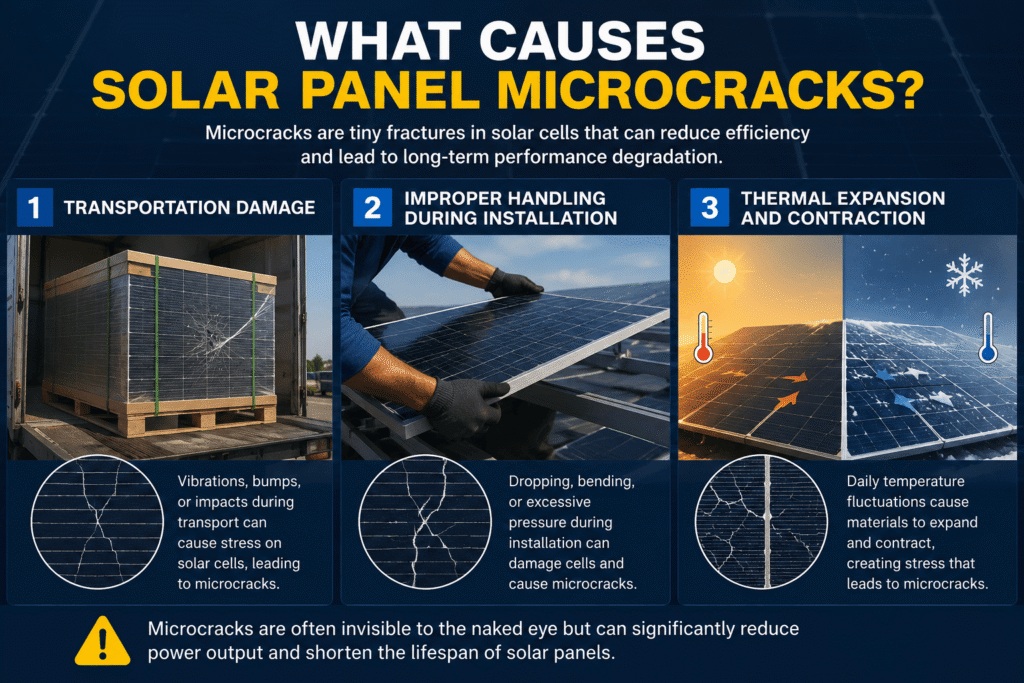
1. Transportation Damage
Solar panels experience vibration and movement during shipping.
Improper packaging or handling may create stress on the cells.
Real Example
Problem: New solar panels underperformed shortly after installation.
Cause: Cell damage during transportation.
Result: Thermal imaging revealed multiple microcracks.
2. Improper Handling During Installation
Solar panels should always be lifted and supported correctly.
Excessive bending or twisting can damage solar cells.
Common Mistakes
- Carrying panels incorrectly
- Applying pressure to the glass
- Dropping panels
3. Thermal Expansion and Contraction
Solar panels expand and contract as temperatures change.
Over thousands of heating and cooling cycles, stress can accumulate.
Common Conditions
- Hot climates
- Large temperature swings
- Rooftop installations
4. Hail and Severe Weather
Even when hail does not visibly crack the glass, internal cell damage may occur.
Potential Effects
- Microcracks
- Cell fractures
- Hot spots
5. Heavy Snow Loads
Excessive snow accumulation can place significant pressure on solar panels.
This pressure may contribute to internal cell stress.
6. Manufacturing Defects
In some cases, defects introduced during manufacturing can make cells more vulnerable to cracking.
How Microcracks Affect Solar Panel Performance
The impact depends on:
- Crack size
- Crack location
- Number of affected cells
Minor Microcracks
May cause little or no measurable performance loss.
Severe Microcracks
Can result in:
- Significant power loss
- Hot spot formation
- Faster degradation
- Reduced panel lifespan
Real Example
Panel Output When New: 400W
After Several Years: 340W
Investigation: Multiple cell microcracks identified.
Result: Noticeable reduction in energy production.
Microcracks and Solar Panel Hot Spots
Microcracks are one of the leading causes of solar panel hot spots. When current cannot flow evenly through damaged cells:
- Resistance increases
- Heat builds up
- Localized overheating occurs
This can accelerate damage and reduce efficiency.
Why Microcracks Lead to Overheating
Microcracks disrupt current flow. This creates resistance. Resistance creates heat.
The result: Localized hot spots.
Warning Signs
- Production decline
- Uneven panel temperatures
- Thermal imaging anomalies
Can Microcracks Cause Moisture Problems?
Indirectly, yes.
As damage progresses:
- Protective layers may weaken
- Moisture intrusion risk may increase
- Corrosion can develop
These issues can further reduce panel performance.
How Much Power Can Microcracks Reduce?
The actual power loss varies significantly.
Typical Scenarios
Minor Microcracks:
- Negligible loss
Moderate Microcracks:
- Noticeable reduction over time
Severe Microcracks:
- Significant output decline
- Hot spots
- Premature panel replacement
Real Example
Original Output: 400W
Current Output: 350W
Investigation: Extensive cell microcracking.
Result: Panel replacement required.
How Are Microcracks Detected?
Because microcracks are often invisible, specialized testing is usually required.
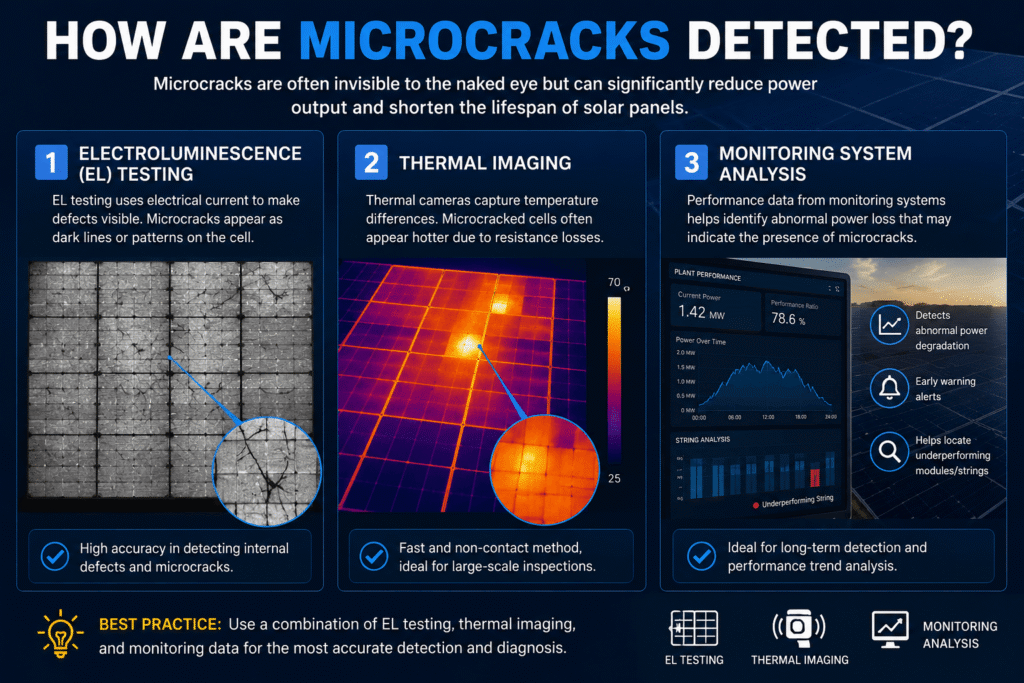
Electroluminescence (EL) Testing
One of the most effective methods.
Electroluminescence testing can reveal:
- Hidden cell fractures
- Manufacturing defects
- Performance-related damage
Thermal Imaging
Thermal cameras identify:
- Hot spots
- Uneven temperatures
- Underperforming cells
Monitoring System Analysis
Performance monitoring can reveal:
- Gradual output decline
- Abnormal production patterns
Can Solar Panel Microcracks Be Repaired?
Generally, no. Once a solar cell develops microcracks, repairing the internal structure is not practical.
Possible Actions
Monitor
For minor microcracks with no measurable performance impact.
Replace
For panels showing:
- Significant power loss
- Hot spots
- Progressive degradation
Do Warranties Cover Microcracks?
Coverage depends on the cause.
Potentially Covered
- Manufacturing defects
- Material failures
Usually Not Covered
- Improper installation
- Mishandling
- External impacts
Related Guide: Solar Panel Warranty
Example
Microcracks caused during manufacturing: May qualify for warranty replacement.
Microcracks caused by someone walking on the panel: Typically not covered.
Do All Microcracks Cause Power Loss?
Can Solar Panels Still Work with Microcracks? Yes. Not all microcracks immediately affect performance.
The impact depends on:
- Crack size
- Crack location
- Number of affected cells
- Whether the crack interrupts current flow
Example
Minor microcrack: No measurable production loss
Severe microcrack:
- Reduced output
- Hot spot formation
- Accelerated degradation
Microcracks vs Visible Cracks
| Feature | Microcracks | Visible Cracks |
|---|---|---|
| Visible to Eye | Usually No | Yes |
| Location | Inside Solar Cells | Glass or Cells |
| Detection Method | EL Testing | Visual Inspection |
| Immediate Impact | Often Small | Can Be Significant |
| Repair | Usually Not Possible | Often Requires Replacement |
This section naturally links to: Solar Panel Cracks
Real Homeowner Scenarios
Scenario 1: Hidden Shipping Damage
Problem: Newly installed system underperformed.
Cause: Microcracks caused during transportation.
Solution: Warranty replacement.
Scenario 2: Hailstorm Damage
Problem: Production gradually decreased.
Cause: Internal cell fractures from hail impact.
Solution: Panel replacement.
Scenario 3: Long-Term Thermal Stress
Problem: Output declined faster than expected.
Cause: Microcrack progression over several years.
Solution: Monitoring and selective panel replacement.
How Fast Do Microcracks Spread?
Do Microcracks Get Worse Over Time? Sometimes.
Microcracks may expand due to:
- Daily temperature cycles
- Wind loading
- Snow loads
- Mechanical stress
Real Example
Year 1: Minor microcrack detected.
Year 4: Noticeable power loss.
Cause: Progressive crack growth and cell isolation.
How to Prevent Solar Panel Microcracks
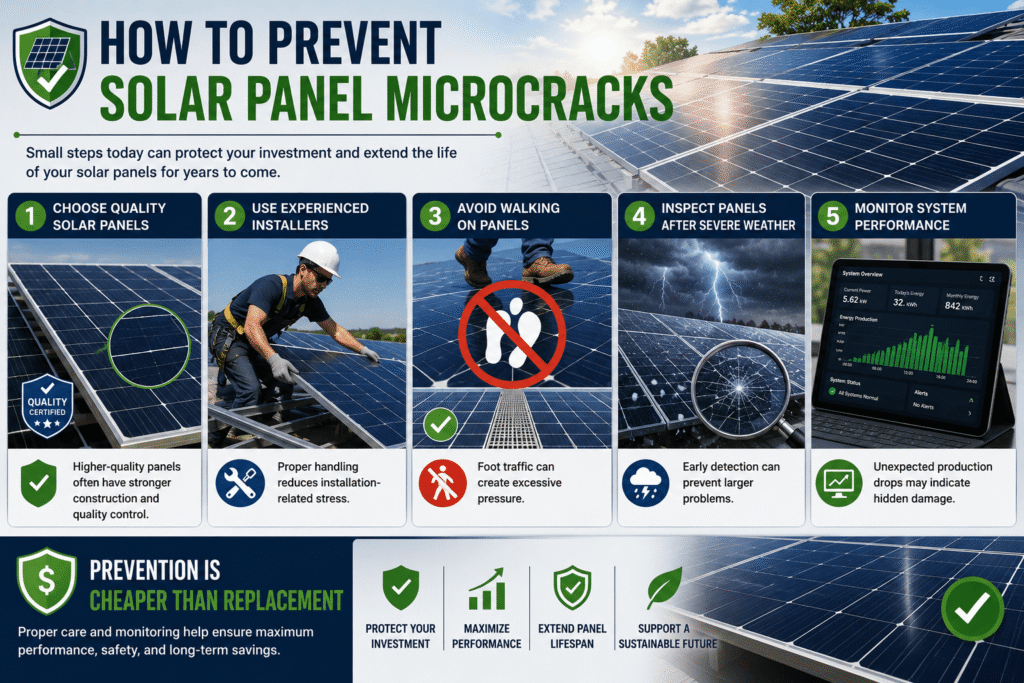
Choose Quality Solar Panels
Higher-quality panels often have stronger construction and quality control.
Use Experienced Installers
Proper handling reduces installation-related stress.
Avoid Walking on Panels
Foot traffic can create excessive pressure.
Inspect Panels After Severe Weather
Early detection can prevent larger problems.
Monitor System Performance
Unexpected production drops may indicate hidden damage.
Which Solar Panels Are Most Vulnerable?
Some panels are more susceptible than others.
Risk factors include:
- Lower-quality manufacturing
- Poor transportation practices
- Thin wafer designs
- Improper installation
How to Reduce Risk
- Purchase from reputable manufacturers
- Use experienced installers
- Inspect panels upon delivery
When Should You Replace a Panel?
Replacement should be considered if:
- Production drops significantly
- Hot spots develop
- Degradation accelerates
- Multiple cells are affected
FAQs
Can microcracks be seen with the naked eye?
Usually not. Specialized testing is often required.
Do microcracks always reduce power output?
Not necessarily. Small microcracks may have little immediate impact.
Can hail cause solar panel microcracks?
Yes. Internal cell damage may occur even if the glass appears undamaged.
Are microcracks covered under warranty?
Coverage depends on whether the damage resulted from manufacturing defects or external causes.
Can microcracks cause hot spots?
Yes. Damaged cells may create localized overheating.
Should I replace a panel with microcracks?
Replacement is usually only necessary if performance declines significantly or hot spots develop.
Can microcracks spread over time?
Yes. Temperature changes and mechanical stress may cause existing microcracks to grow.
Are microcracks dangerous?
Usually not immediately, but they can contribute to hot spots and long-term degradation.
Can thermal imaging detect microcracks?
Thermal imaging may identify resulting hot spots, but EL testing is generally more effective for directly identifying microcracks.
Can microcracks happen during installation?
Yes. Improper handling is one of the most common causes.
Final Thoughts
Solar panel microcracks are one of the most common hidden forms of solar panel damage.
Although they may not be immediately visible, they can reduce energy production, contribute to hot spots, and accelerate panel degradation over time.
Regular monitoring, professional inspections, and careful handling during installation are the best ways to minimize the risk of microcrack-related performance issues and protect your solar investment for decades.
