
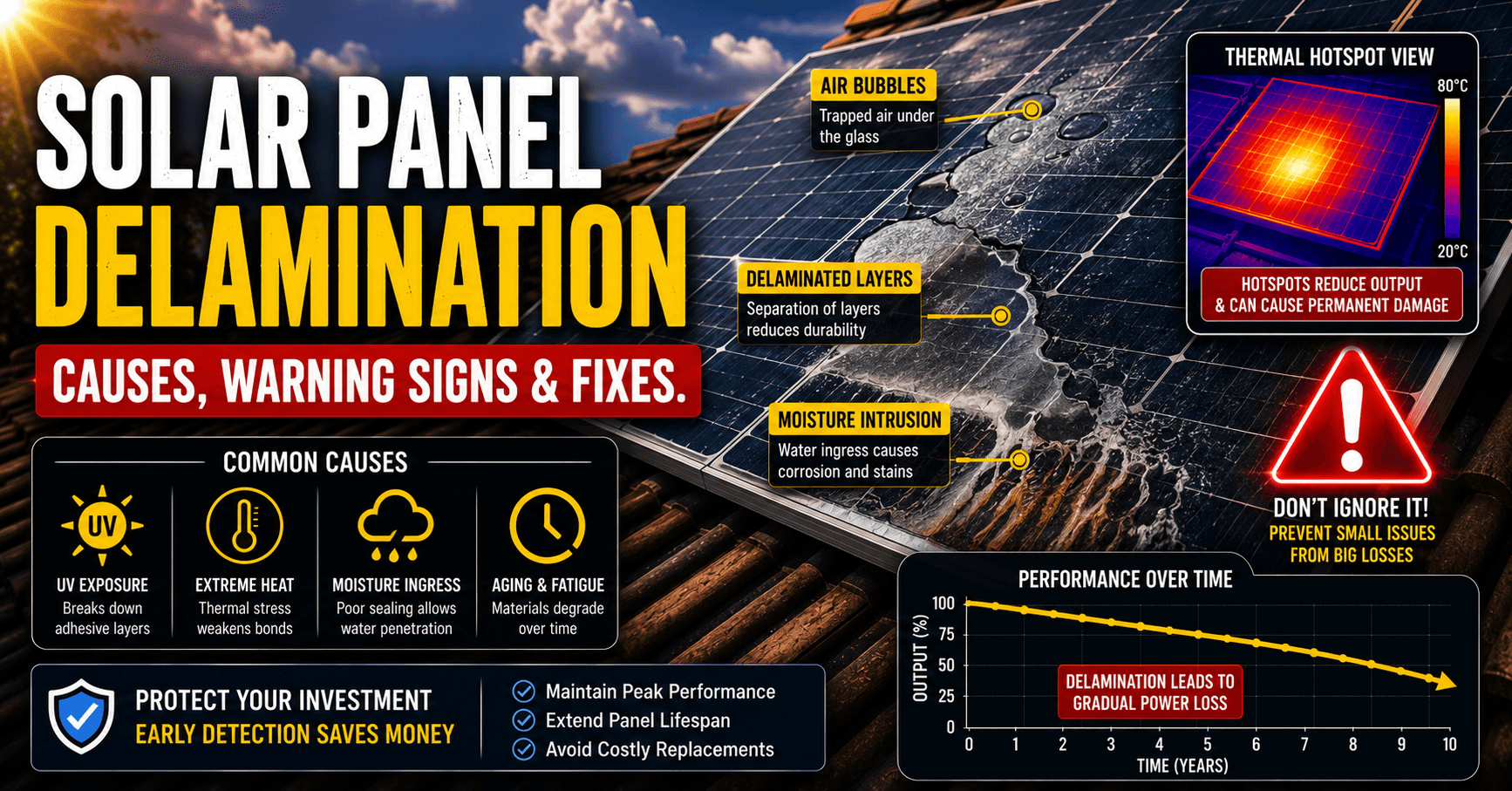

Solar panels are designed to withstand decades of exposure to sunlight, rain, wind, and temperature changes. However, over time, some panels may develop a condition known as delamination. Solar panel delamination occurs when the layers inside a solar panel begin separating from each other.
While it may initially appear to be a cosmetic issue, delamination can reduce energy production, accelerate panel degradation, and eventually lead to complete panel failure.
In this guide, you’ll learn:
- What solar panel delamination is
- What causes it
- Warning signs to watch for
- How it affects solar performance
- Repair and replacement options
- Warranty considerations
- Prevention methods
Quick Answer
Solar panel delamination occurs when the protective layers inside a solar panel separate due to manufacturing defects, aging, moisture, heat, or environmental stress.
Common warning signs include:
- Air bubbles under the glass
- Discoloration
- Moisture intrusion
- Reduced solar output
- Hot spots
Severe delamination often requires panel replacement because it can permanently damage solar cells.
What Is Solar Panel Delamination?
A solar panel consists of multiple layers:
- Tempered glass
- Encapsulant material
- Solar cells
- Backsheet
- Frame
These layers are bonded together during manufacturing.
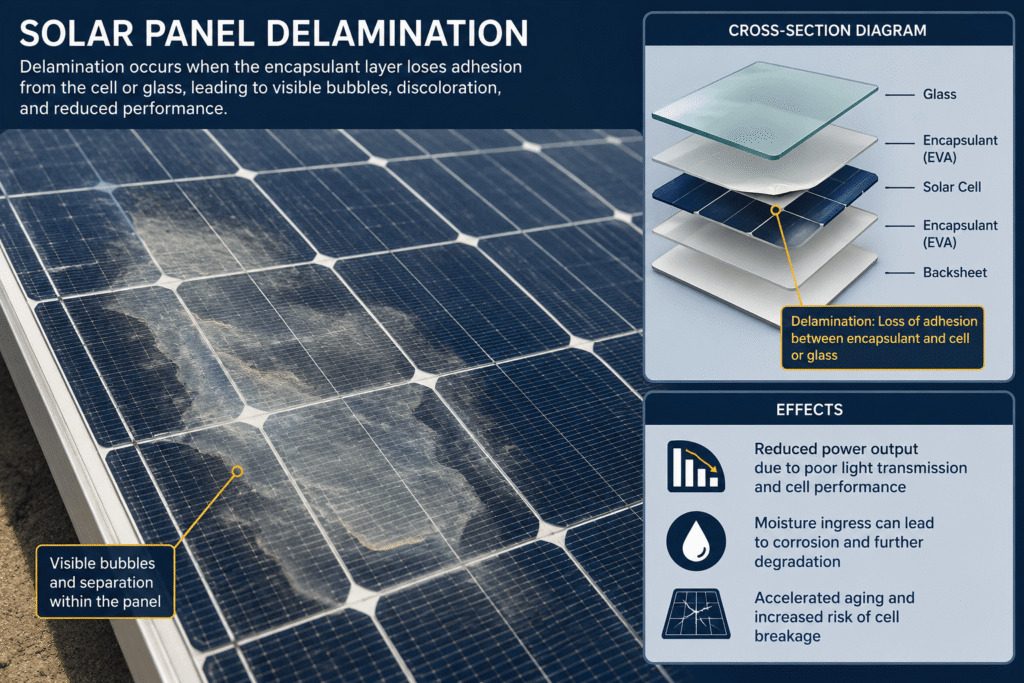
Delamination occurs when the bond between these layers begins to fail.
As separation progresses:
- Moisture may enter the panel
- Cells may degrade faster
- Performance can decline
Warning Signs of Solar Panel Delamination
Delamination is often visible during a close inspection.
Common signs include:
- Bubbles beneath the glass
- Peeling layers
- Yellow or brown discoloration
- Cloudy appearance
- Moisture inside the panel
- Reduced power production
What Causes Solar Panel Delamination?
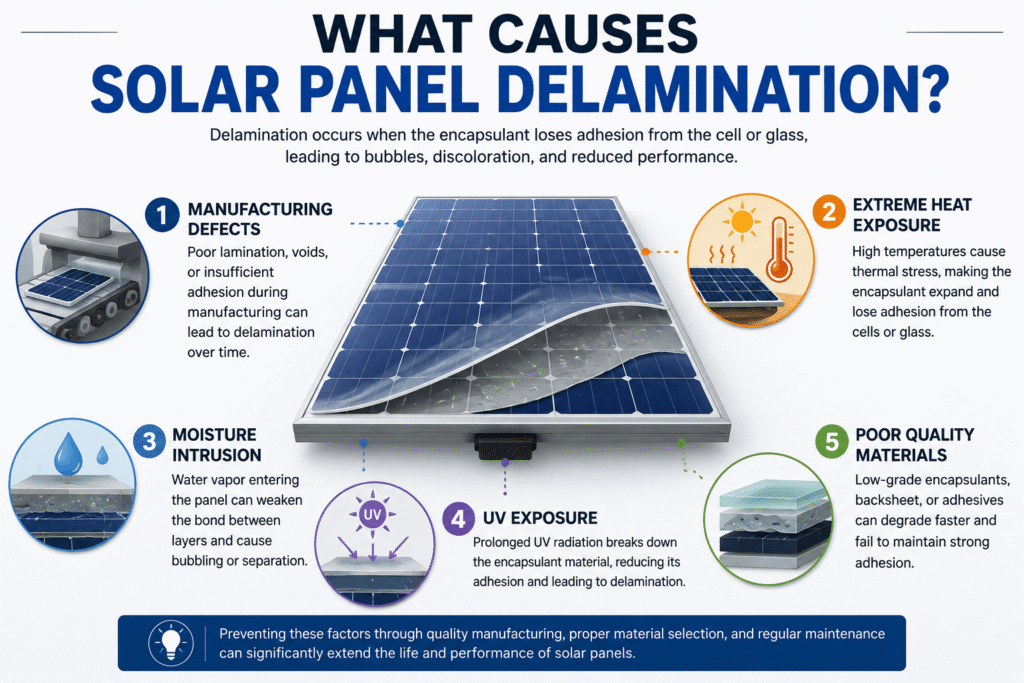
1. Manufacturing Defects
Poor bonding during manufacturing is one of the leading causes.
If the encapsulant does not properly adhere to surrounding layers, separation may occur over time.
Real Example
Problem: Panel developed air bubbles after several years.
Cause: Manufacturing defect.
Result: Warranty replacement approved.
2. Extreme Heat Exposure
Solar panels experience repeated heating and cooling cycles.
Over time, thermal stress can weaken internal bonds.
Higher Risk Areas
- Desert climates
- Very hot rooftops
- Areas with large temperature swings
3. Moisture Intrusion
Water entering a solar panel can accelerate adhesive breakdown.
Possible entry points include:
- Damaged seals
- Cracked glass
- Manufacturing defects
4. UV Exposure
Solar panels receive thousands of hours of UV exposure.
Over decades, UV radiation may gradually degrade encapsulant materials.
5. Poor Quality Materials
Lower-quality materials may age more rapidly and become more susceptible to delamination.
How Delamination Affects Solar Panel Performance
The impact varies depending on severity.
Reduced Energy Production
Separated layers can interfere with light transmission and electrical performance.
Increased Degradation
Moisture and contamination may accelerate cell aging.
Hot Spot Formation
Electrical resistance can increase in affected areas.
Reliability Issues
Delaminated panels often become more vulnerable to future failures.
Delamination and Solar Panel Hot Spots
Delamination can contribute to hot spot development.
When layers separate:
- Heat dissipation becomes less effective
- Electrical resistance may increase
- Localized overheating can occur
Real Example
Problem: Panel consistently ran hotter than neighboring panels.
Inspection: Thermal imaging identified a delaminated section.
Result: Reduced output and elevated temperatures.
Related Guide: Solar Panel Hot Spots
Solar Panel Delamination and Moisture Intrusion
One of the most serious risks is moisture entering the panel.
Potential consequences include:
- Corrosion
- Electrical faults
- Reduced insulation
- Cell degradation
Real Example
Problem: Panel continued producing power but output gradually declined.
Cause: Moisture intrusion through a delaminated area.
Result: Panel replacement required.
How to Detect Solar Panel Delamination
Visual Inspection
Look for:
- Air bubbles
- Peeling layers
- Discoloration
- Cloudy sections
Thermal Imaging
Thermal cameras can reveal:
- Hot spots
- Temperature irregularities
- Underperforming areas
Monitoring System Data
Watch for:
- Production decline
- Unexpected performance losses
Professional Inspection
Recommended when:
- Delamination is widespread
- Warranty claims may be involved
Can Solar Panel Delamination Be Repaired?
In most cases: No.
Delamination affects the internal structure of the solar panel.
Because the panel is factory-laminated, restoring the original bond is generally not practical.
Minor Delamination
May continue operating for years with careful monitoring.
Severe Delamination
Often requires replacement.
Repair vs Replacement
| Condition | Recommended Action |
|---|---|
| Small isolated bubble | Monitor |
| Minor discoloration | Inspect regularly |
| Moisture intrusion | Replace |
| Significant output loss | Replace |
| Extensive delamination | Replace |
Early Stage vs Advanced Delamination
Does All Solar Panel Delamination Require Replacement? Not necessarily.
The severity of delamination determines the appropriate action.
| Delamination Severity | Typical Impact | Recommended Action |
|---|---|---|
| Small Isolated Bubble | Minimal | Monitor |
| Minor Edge Separation | Low | Regular Inspection |
| Visible Moisture Intrusion | Moderate to High | Professional Inspection |
| Large Areas of Separation | High | Replacement |
Real Example
Problem: Small bubble near panel edge.
Result: No measurable performance loss after two years.
Action: Annual inspections and monitoring.
Delamination vs Cracks
Many homeowners confuse cracks and delamination.
| Feature | Delamination | Crack |
|---|---|---|
| Appearance | Bubbles or layer separation | Visible fracture |
| Primary Cause | Bond failure | Physical impact or stress |
| Moisture Risk | High | High |
| Visible to Eye | Usually Yes | Usually Yes |
| Common Fix | Replacement | Repair or replacement depending on severity |
Related Guide: Solar Panel Cracks
Is Solar Panel Delamination Covered Under Warranty?
Potentially, yes. Coverage depends on the cause.
Often Covered
- Manufacturing defects
- Material failures
- Workmanship issues
Usually Not Covered
- Physical damage
- Improper installation
- Accidental impacts
Real Example
Delamination caused by poor factory bonding: Potential warranty claim.
Delamination following storm-related damage: May fall under insurance rather than warranty.
Related Guide: Solar Panel Warranty
Real Homeowner Scenarios
Scenario 1: Air Bubble Under Glass
Cause: Manufacturing defect.
Result: Warranty replacement.
Scenario 2: Yellowing Around Cells
Cause: UV-related aging.
Result: Moderate production loss.
Scenario 3: Moisture Inside Panel
Cause: Progressive delamination.
Result: Panel replacement required.
How to Prevent Solar Panel Delamination
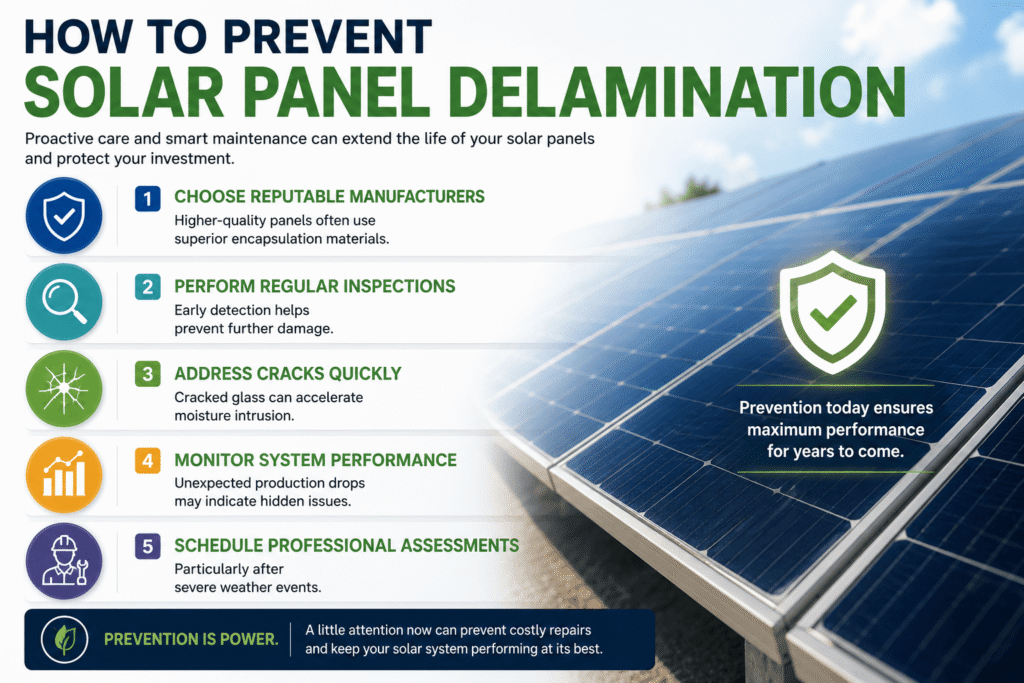
Choose Reputable Manufacturers
Higher-quality panels often use superior encapsulation materials.
Perform Regular Inspections
Early detection helps prevent further damage.
Address Cracks Quickly
Cracked glass can accelerate moisture intrusion.
Monitor System Performance
Unexpected production drops may indicate hidden issues.
Schedule Professional Assessments
Particularly after severe weather events.
Can Delaminated Solar Panels Still Work?
Do Delaminated Panels Stop Producing Power? Often no.
Many delaminated panels continue generating electricity.
However:
- Efficiency may decline
- Degradation may accelerate
- Moisture-related problems may develop
Real Example
Panel Output When New: 400W
After Delamination Appeared: 375W
After Several Years: 330W
Cause: Progressive moisture-related degradation.
Can Delamination Spread?
Does Delamination Get Worse Over Time? In many cases, yes.
Contributing factors include:
- Heat
- UV exposure
- Moisture
- Thermal cycling
What begins as a small bubble can eventually expand across a larger section of the panel.
Delamination and Solar Panel Efficiency
Why Does Delamination Reduce Performance? Solar panels depend on:
- Proper light transmission
- Cell protection
- Thermal stability
When layers separate:
- Light transmission may decrease
- Heat buildup may increase
- Electrical performance may decline
Warning Signs
- Reduced daily production
- Uneven panel temperatures
- Faster-than-normal degradation
Related Guide: Solar Panel Efficiency
What Happens If Delamination Is Ignored?
Long-Term Risks
Ignoring delamination may lead to:
- Reduced energy production
- Corrosion
- Moisture intrusion
- Hot spots
- Premature panel failure
Example
Year 1: Small bubble under glass.
Year 5: Moisture entered the panel.
Result: Significant production loss and replacement.
How Long Can a Delaminated Panel Last?
Minor delamination:
- May continue operating for years
Moderate delamination:
- Requires close monitoring
Severe delamination:
- Often requires replacement
No two cases are identical. Regular monitoring is the best way to determine whether performance is being affected.
When Should You Replace a Delaminated Panel?
Replacement is recommended if:
- Production drops significantly
- Moisture enters the panel
- Hot spots develop
- Delamination spreads
- Electrical safety concerns arise
FAQs
What is solar panel delamination?
Delamination occurs when the bonded layers inside a solar panel begin separating from each other.
Does delamination reduce solar panel efficiency?
Yes. Delamination can reduce energy production and accelerate panel degradation.
Can delaminated solar panels still work?
Often yes, especially during the early stages. However, performance may decline over time.
Is delamination covered under warranty?
If caused by manufacturing defects, warranty coverage may apply.
Can delamination cause hot spots?
Yes. Layer separation may contribute to localized overheating.
Should I replace a delaminated solar panel?
If delamination is extensive or affects performance, replacement is usually recommended.
Can solar panel delamination be repaired?
In most cases, no. Delamination affects the laminated structure of the panel and usually cannot be permanently repaired.
Can delamination cause power loss?
Yes. The severity depends on the extent of the separation and whether moisture intrusion occurs.
Is delamination covered under warranty?
If caused by manufacturing defects, warranty coverage may apply.
How do I know if my panel is delaminating?
Look for bubbles, discoloration, peeling layers, cloudiness, and unexplained performance loss.
Can delamination lead to panel failure?
Yes. Severe delamination can eventually cause significant degradation and loss of power production.
Final Thoughts
Solar panel delamination is a relatively common aging and manufacturing-related issue that can reduce performance, accelerate degradation, and increase the risk of moisture-related damage.
While minor delamination may only require monitoring, severe cases often justify panel replacement.
Regular inspections, performance monitoring, and prompt action can help identify delamination early and protect the long-term value of your solar investment.
