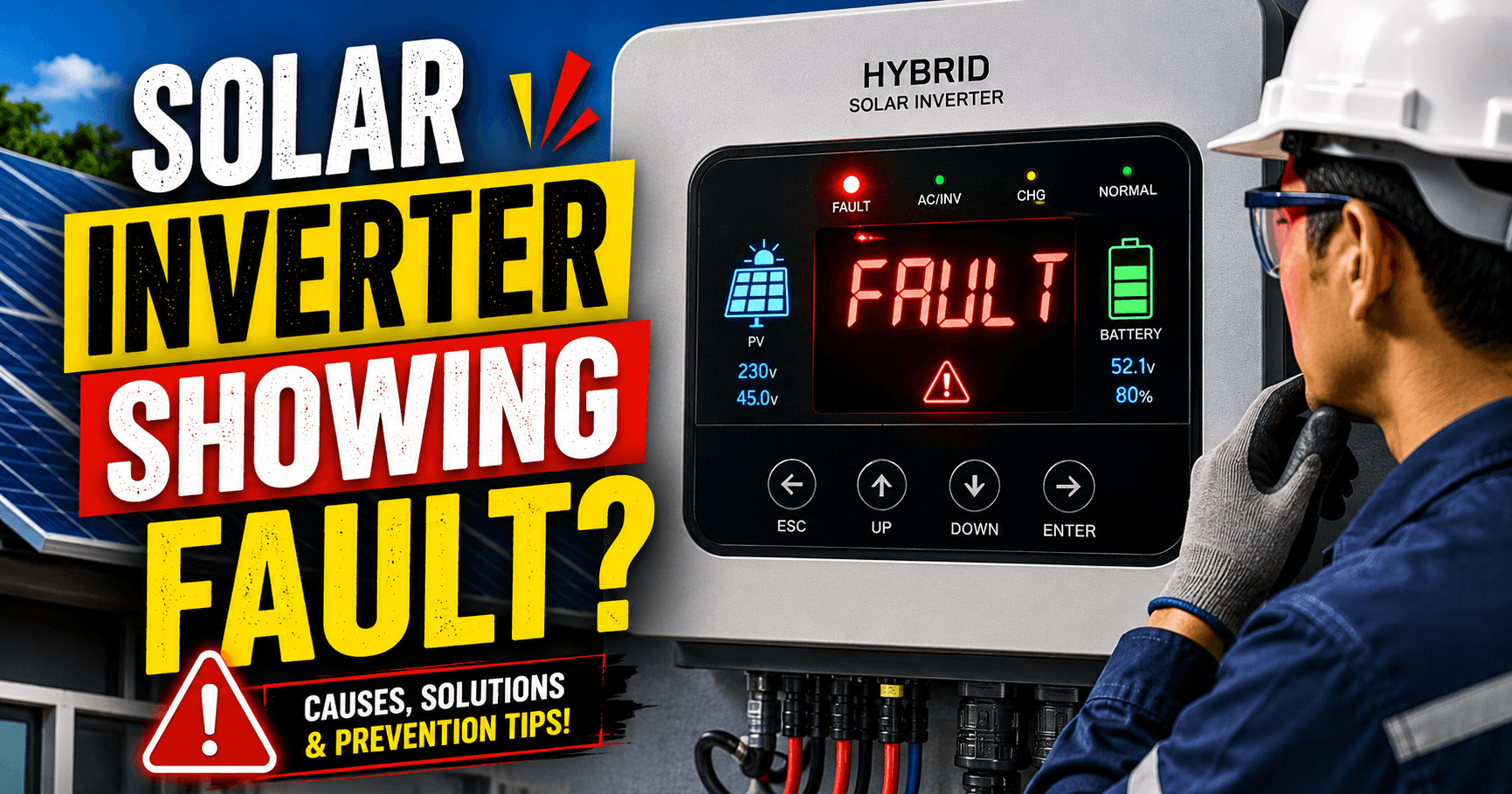

If the solar inverter showing fault, warning light, or error code, don’t panic. Solar inverters are designed with built-in protection systems that detect abnormal operating conditions and alert homeowners before serious damage occurs.
A fault message does not always mean the inverter is defective. In many cases, the issue is caused by:
- Low battery voltage
- Overload conditions
- Grid voltage fluctuations
- Poor solar production
- Communication errors
- Temporary environmental conditions
The good news?
Most solar inverter faults can be diagnosed and resolved without replacing the inverter.
In this complete troubleshooting guide, you’ll learn:
- Why solar inverters show fault messages
- The most common inverter faults
- Real-world examples
- Step-by-step troubleshooting
- When to call a technician
Quick Answer
If you are facing solar inverter showing fault issue, the most common causes include:
- Battery problems
- Overload conditions
- Grid issues
- Overheating
- Wiring faults
- Solar panel underperformance
- Communication errors
Most faults are safety mechanisms designed to protect the inverter, battery, and connected appliances.
Common Signs of a Solar Inverter Showing Fault
You may notice:
- Red warning light
- Fault message on display
- Error code
- Beeping alarm
- Inverter shutdown
- Repeated restarting
- Reduced solar production
- Battery not charging
Some systems continue operating with reduced performance while others shut down completely.
What Does an Inverter Fault Mean?
A fault means the inverter has detected an operating condition outside its normal range.
Examples include:
- Voltage too high
- Voltage too low
- Temperature too high
- Excessive load
- Communication failure
Modern inverters continuously monitor system performance and trigger protective actions when necessary.
1. Low Battery Fault
One of the most common solar inverter faults.
When battery voltage drops below the inverter’s safe operating threshold:
👉 The inverter may display:
- Low Battery
- Battery Fault
- Battery Low Voltage
Common Causes
- Aging battery
- Deep discharge
- Charging failure
- Weak battery cells
Real Example
A homeowner noticed the inverter showing a battery fault every evening.
Cause: Battery capacity had deteriorated after years of usage.
Solution: Battery replacement restored normal operation.
Related Guides
2. Overload Fault
Overload faults occur when connected appliances draw more power than the inverter can safely supply.
Common Appliances Causing Overload
- Air conditioners
- Water pumps
- Electric heaters
- Multiple heavy appliances running simultaneously
Real Example
Inverter Rating: 3 kW
Connected Load:
- Air conditioner
- Water heater
- Refrigerator
Total demand exceeded inverter capacity.
Result: Overload fault displayed.
Related Guide
3. Over Temperature Fault
Solar inverters generate heat during operation.
If internal temperatures become excessive: The inverter may trigger an over-temperature fault.
Causes
- Poor ventilation
- Dust buildup
- Direct sunlight exposure
- Faulty cooling fan
Symptoms
- Loud fan operation
- Reduced power output
- Unexpected shutdowns
Related Guide
4. Grid Fault
Grid-connected and hybrid inverters continuously monitor utility power quality.
If grid voltage or frequency moves outside acceptable limits: A grid fault may occur.
Common Causes
- Voltage fluctuations
- Power outages
- Utility maintenance work
- Poor local grid quality
Real Example
A homeowner experienced repeated grid fault warnings during evening peak demand.
Cause: Neighborhood voltage fluctuations.
Solution: Issue resolved after utility adjustments.
5. Low Solar Input Fault
Insufficient solar production may trigger fault messages in some systems.
Causes
- Dirty solar panels
- Heavy cloud cover
- Shading
- Damaged panels
Real Example
A system displayed low PV input warnings.
Cause: Heavy dust accumulation on panels.
Solution: Professional cleaning restored production.
Related Guides
6. Communication Fault
Modern solar systems rely on communication between:
- Inverter
- Battery
- Monitoring systems
- Smart meters
Communication failures may trigger warnings.
Common Causes
- Loose cables
- Firmware issues
- Network problems
- Battery communication failure
Symptoms
- Monitoring app offline
- Battery not detected
- Random fault messages
7. Fault Appears Only at Night
Many homeowners notice faults appearing only after sunset.

Possible Causes
- Weak battery
- Nighttime overload
- Low battery voltage
- Battery communication issues
Real Example
Daytime operation: Normal
Nighttime: Repeated fault warnings
Cause: Battery voltage dropped below operating threshold.
Related Guide
8. Internal Inverter Fault
Occasionally the inverter itself develops internal issues.
Possible Problems
- Failed capacitors
- Faulty relays
- Control board failure
- Cooling fan failure
Symptoms
- Persistent faults
- Repeated shutdowns
- Burning smell
- No power output
How to Troubleshoot Solar Inverter Showing Fault Issue
Step 1: Read the Error Code
Most inverters display specific fault codes.
Record:
- Fault number
- Warning message
- Time of occurrence
Step 2: Check Battery Status
Inspect:
- Battery voltage
- Charge percentage
- Battery temperature
Step 3: Inspect Solar Production
Verify:
- Daily generation
- Panel cleanliness
- Shading conditions
Step 4: Reduce Connected Load
Temporarily switch off:
- Air conditioners
- Water heaters
- High-power appliances
Step 5: Check Ventilation
Ensure:
- Cooling vents are clear
- Dust is removed
- Airflow is adequate
Step 6: Restart the System
Many temporary faults clear after:
- Inverter restart
- Battery restart
- System reset
Common Solar Inverter Fault Codes and Meanings
| Fault Message | Possible Cause | Recommended Action |
|---|---|---|
| Low Battery Fault | Weak or discharged battery | Check battery voltage |
| Overload Fault | Excess appliance load | Reduce load |
| Grid Fault | Voltage or frequency issue | Check utility supply |
| Over Temperature | Poor ventilation | Improve airflow |
| PV Low Voltage | Low solar input | Inspect panels |
| Communication Fault | Cable or network issue | Check connections |
| Battery Communication Fault | Battery-inverter mismatch | Inspect battery settings |
👉 Different manufacturers use different fault codes, but the underlying causes are often similar.
Real-World Case Studies
Case 1: Battery Fault Every Evening
Problem: Inverter fault appeared after sunset.
Cause: Battery degradation.
Solution: Battery replacement.
Result: Normal operation restored.
Case 2: Frequent Overload Faults
Problem: Overload warning daily.
Cause: Air conditioner and water heater running together.
Solution: Reduced simultaneous usage.
Result: No further overloads.
Case 3: Grid Fault During Peak Hours
Problem: Grid fault warnings in the evening.
Cause: Local voltage instability.
Solution: Utility provider intervention.
Result: Stable operation.
Inverter Showing Fault but Still Producing Power
Some inverters continue operating even when a fault is present.
This usually happens when:
- The fault is temporary
- The inverter has entered a reduced-output mode
- The issue is not severe enough to require shutdown
Examples include:
- High temperature warnings
- Minor communication errors
- Temporary grid fluctuations
The system may continue producing power while alerting you to a developing issue.
Why Does My Solar Inverter Show Fault Only During the Day?
If the fault appears only when solar production is high, possible causes include:
- Overheating
- High PV voltage
- Inverter overload
- Solar panel wiring issues
Real Example
Problem: Fault appears around noon every day.
Cause: Poor ventilation caused inverter temperatures to rise during peak production.
Solution: Improved airflow around inverter.
Result: Fault disappeared.
Why Does My Solar Inverter Show Fault During Rain?
Possible causes include:
- Moisture intrusion
- Loose outdoor connectors
- Ground faults
- Insulation problems
Real Example
A homeowner experienced repeated faults during monsoon season.
Cause: Water entered a damaged MC4 connector.
Solution: Connector replacement.
Result: Normal operation restored.
Can Dirty Solar Panels Cause Inverter Faults?
Indirectly, yes. Dirty panels may:
- Reduce solar production
- Cause low PV voltage warnings
- Affect battery charging
Heavy dust buildup can sometimes trigger low-input fault messages. You can clean the solar panel to make it efficient.
Battery Problems Are a Major Cause of Inverter Faults
Weak batteries may trigger:
- Low voltage fault
- Battery fault
- Communication fault
- Charging fault
Common Signs
- Reduced backup time
- Rapid battery drain
- Nighttime faults
- Frequent fault resets
Preventive Maintenance Checklist
To reduce inverter faults:
- Clean solar panels regularly
- Monitor battery health
- Keep inverter ventilated
- Inspect wiring annually
- Check monitoring app frequently
- Address warning messages early
Preventive maintenance often identifies problems before they trigger system shutdowns.
When Should You Call a Technician?
Seek professional help if:
- Fault returns repeatedly
- Burning smell is present
- Battery overheats
- Wiring damage is visible
- Inverter shuts down completely
- Internal hardware failure is suspected
FAQs
Why is my solar inverter showing fault?
Common causes include battery problems, overload conditions, grid issues, overheating, or communication failures.
Can a weak battery cause inverter faults?
Yes. Weak batteries often trigger low-voltage and battery fault warnings.
Can dirty solar panels cause inverter faults?
Indirectly, yes. Reduced solar production can trigger low-input warnings and charging problems.
Why does my inverter fault only at night?
Nighttime faults are commonly caused by battery discharge issues, overloads, or low-voltage conditions.
Should I reset my inverter after a fault?
Yes, if recommended by the manufacturer and the fault condition has been resolved. However, repeated faults should be investigated rather than continually reset.
Can inverter faults damage my solar system?
Most fault messages are protective mechanisms designed to prevent damage. Prompt troubleshooting helps avoid long-term issues.
How serious is a solar inverter fault?
Some faults are minor warnings, while others indicate issues that require immediate attention. Repeated faults should never be ignored.
Can I reset an inverter fault myself?
Many temporary faults clear after restarting the system. However, recurring faults should be investigated.
Why does my inverter show fault after a power outage?
Grid fluctuations, battery switching, or inverter protection mode may trigger temporary faults after outages.
Can a faulty battery cause inverter fault codes?
Yes. Weak batteries are one of the most common causes of inverter fault warnings.
Why does my inverter show fault only at night?
Nighttime faults are often related to battery discharge, low voltage, or backup load issues.
Final Thoughts
A solar inverter fault does not automatically mean the inverter is defective.
Most faults are caused by:
- Battery problems
- Overload conditions
- Grid fluctuations
- Poor solar production
- Communication issues
By understanding the warning signs and troubleshooting systematically, homeowners can resolve many inverter faults quickly and safely.
Regular maintenance, proper system sizing, and battery monitoring remain the best ways to prevent future inverter fault warnings.